
There was an event in social media back in 2010 that caught my eye and interest. You might remember it… there was a message propagated on Facebook suggesting that people “…change your Facebook profile picture to a cartoon from your childhood. The goal? To not see a human face on fb ’til Monday, December 6. Join the fight against child abuse, copy & paste to your status and invite your friends to do the same.”
Seemed like a good idea. I changed my profile pic to Speed Racer, then copied and pasted the status. A lot of my friends did as well, as did other people. Meanwhile, a mass of negativity was swelling.
This was the origin of the term “slacktivism,” and people became massively offended at the notion that changing one’s profile picture and pasting a copy of a status might actually do anything to help people. It was seen as a cop-out, even as a deterrent to actual activism. People went so far as to claim that giving people the opportunity to do something relatively simple, such as changing a profile picture and a status message, made it less likely that people would donate money to a cause, or do actual work for it.
People became SO incensed at the concept of “slacktivism” in this case that they began propagating a status that the whole “change your profile picture to protest child abuse” meme was an effort by pedophiles… a claim that was rapidly and completely disputed. Yes… someone became so angry about how some people chose to show support for this cause that they found it necessary to generate a vile lie about the effort.
Now, even at the time, I was puzzled by the whole “slacktivism” charge. To this day, I contend that it seems unlikely that a person who was already dedicated to taking some form of action for a cause, moneterily or in the form of personal effort, would think “I was going to donate some money and go down to a volunteer event, but now that I’ve changed my profile picture, I think I’ve done enough!” Frankly, if anyone DID think that, I don’t think I’d want them showing up to a volunteer event.
The often correct Snopes.com even weighed in on the subject, stating that “…real problems don’t dissapear as a consequence of acts of slacktivism; they’re fought through the mechanism of donation of time and/or money” (Barbara Mikelson, http://www.snopes.com/computer/internet/cartoon.asp). However, in the very same article, it was stated that the British charity known as the National Society for the Prevention of Cruelty to Children (NSPCC) appreciated the effort. The NSPCC tweeted that “although the NSPCC did not originate the childhood cartoon Facebook campaign, we welcome the attention it has it has brought to the work we do :)” (ibid).
Some people don’t put much faith in “awareness” campaigns… campaigns designed to raise public awareness about an issue. Most slacktivism campaigns tend to fall into the “awareness” category… “hey, here’s a problem that people need to know about. Do something that draws attention!” Granted, that alone is rarely enough to deal with a problem. However, the “mechanism of donation of time and/or money” requires that people be aware of the need for such donation. Without awareness, who knows that these difficulties require attention?
I had a long discussion with a good friend of mine (whom you may have seen as Twisted Joe in many of my blog’s “comments” sections) about this. We were both convinced of one fact- there must be a right way to do this thing.
Making people aware of a problem is one thing, and an important thing. But that awareness must come with a capacity for action. There needs to be not only a “here’s a problem,” but also a “here’s what you can do about it.”
So, we chose a difficulty… something fairly broad yet still meaningful; mental health. No, not just ’cause we’re generally kind of nuts, but because both of our lives have been deeply affected by mental illness in people we are close to.
I’ve done some research into organizations that work with mental health, who have opportunities for the community to assist at least in the form of donations. I’ve decided on Mental Health America. They’ve been working for over a century through advocacy, education, and programs to help those who suffer from mental illness. More, there doesn’t seem to be much (if any) negative reporting on them. It’s a legitimate charity for the chosen cause with opportunities to assist through donation.
Here is the status that I intend to put up on my social networking accounts as soon as I post up this blog. I encourage you to copy and paste it as well.

“I have changed my profile picture to something silver. Silver is the ribbon color for the awareness of problems with mental health. Millions of people are affected by mental illness, whether they suffer from it themselves, or suffer the agony of having someone close to them affected by it. The silver profile is to raise awareness of the difficulty, but it is not enough.
Mental Health America (http://www.nmha.org/) is an organization which has been working for over a century to help those affected by mental illness. Please visit http://www.mentalhealthamerica.net/go/donate and give what you can, no matter how great or small. Every little bit helps them to work in advocacy, education, and with programs and services.
If you’d like to help to spread awareness of this issue, and the opportunity for action, please share this status. The farther this message reaches, the more people gain the opportunity to help with this devastating problem.”
The one thing missing from this model, so far, is feedback… it will be difficult to tell how much effect, if any, this message has. What I request is that those reading this blog comment on it (even a “hi” or an “ok”), and share it. That, and hopefully a propagation of the silver campaign, may be a good indicator of just how much good we can really do.
People have been saying that social networks can be a real power for advocacy and charity in today’s society, but whenever someone gives it a try, a chorus of voices rises to say “that doesn’t really work, you know.” Well, let’s make it work. I continue to contend that there is a right way to do this. One step at a time, let’s find it.
Creative Depletion: The Recuperation From
So, I had a breakdown. It happens… I’m horrible at taking care of myself, I eat like I’m still in my twenties, and I’m constantly trying to produce material for one or more RPG product lines; constantly like it’s an obsessive-compulsive disorder. Add to that a schedule of playing and running RPGs to playtest material and keep my skills up, and, well, every so often, I break down.
According to the people close to me who monitor these things, this most recent breakdown wasn’t one of my worst. Being the most recent, however, it seemed like the worst; the last one always does. Still, I managed to get a little something produced and on the shelf, so no, not the worst.
Back in the mid 90’s, I was really, really trying to get a degree in psychology. I was struggling through the requirements for a general transfer degree from Santa Monica City college, which would not only be an Associate of the Arts in Psych but would transfer directly to a higher degree program at just about any University of California or California State University. I’m not sure exactly why it didn’t work out – maybe it was the Political Science requirement (because a class with material that is both Draconian AND Machiavellian should probably be taught by people who aren’t the human equivalent of a bottle of sleeping pills), maybe it was the fact that I still struggled with higher mathematics, maybe it was even the fact that the admin office constantly read the form where I said Psychology was my major and substituted Cosmetology instead. Still, I learned some stuff.
Say what you want to about the creative process, it all still boils down to neurology. I understand the physiological process of creative depletion pretty well, actually. The brain is made up of cell assemblies; circuits of neurons, if you will, that accomplish different mental tasks. These assemblies are in turn made out of individual neurons connected in networks. The cell assemblies, which can be responsible for anything from the recognition of the color “blue” to the proper pen position for cursive writing or even the creation of gaming material, operate when the neurons are triggered to release neurochemicals. These chemicals bridge the gaps between neurons, or “synapses,” causing other neurons in the network to fire or stop firing. So, to engage the creative processes, one has to go to the stimuli that cause the proper cell assemblies to operate.
There is a problem in this process, though; while each neuron generates its own stores of neurochemicals, this chemical production can be out-stripped by constant neural activity. Fire off a neuron too often, and it has to take time to build up a fresh store of neurochemicals. If you deplete a neuron (or set of neurons), and keep trying to fire it off, you’ll only expend what little neurochemical has been generated to little or no effect. No, you have to rest up the neurons every so often, and allow them to replenish themselves.
So, I fired off my neurons way, way too often, for too long, without giving them a chance to rest up. That’s never a good thing, and it leads to a person reaching for a mental skill or ability only to find that it isn’t currently available. It’s kind of like over-using a muscle, except unlike an over-worked muscle, neurons give you no indication that they’re about to fail. If I do too many push-ups (which isn’t that many, for me, because I take horrible care of myself), my muscles will start to hurt, letting me know that I’m approaching a limit. If I write too many RPG supplements, there’s no pain (except a slight headache which is indistinguishable from simple stress). There’s only a day where I sit at my computer, boot up InDesign, and slam my forehead into the keyboard for an hour because there are no words in my head.
One of the best things I’ve ever done, when I was at complete creative depletion, was to go to a week-long intensive class that taught me the California Life Insurance Code. Using other, little-used areas of the brain encourages the production of neurochemicals, and gives the depleted areas of the brain a much-needed rest at the same time.
This time? A week in Vegas, completely away from computer and creative tools. I didn’t even do any gambling, so I wasn’t running statistics and probabilities in my head. Well, I did go for a few rounds of roulette, but I let other people give me the numbers to play.
End result? I think I’m ready to go again, freshly charged-up and full of creative potential once more. That, and a determination to take better care of myself, because a healthy body better supports an active mind.
I keep forgetting, you see, to refill my stores of expended creativity. Comes along with the obsessive personality. I need to take time to read, to watch the occasional movie, to game other people’s games, and to sit back and relax a little.
Because there might be twenty-seven books that need my attention… but twenty minutes in the hot tub will make them, and me, a higher quality.
The Corum Incorrectness Spectrum


Fair warned be ye – that’s Ranty up there. I’m likely to get a little harsh in this post. So… political discourse.
While paying attention to the general political discourse of the country over the past few months, I’ve been struck by something. An awful lot of it isn’t correct.
I’m not talking about people’s opinions on particular nominees or stances on one side of the Conservative/Liberal Republican/Democrat spectrum or the other. I don’t like to judge people’s opinions. Opinions are deeply personal things, held for any number of reasons. They can be deeply held, and can go so far as to become convictions. No, I’m not going to tell someone that their opinions or convictions are wrong. What I’m referring to are the facts that people are using to demonstrate their points, or conclusions that are being reached strictly on the basis of stated facts or logical conjecture.
I won’t say that someone’s opinions are wrong; opinions are subjectively held. I will, however, point out where people’s facts or conjecture are wrong. Why the distinction?
I don’t know of any reliable tests to determine the veracity of an opinion. “I think that this is better than that.” Well, to that person, this actually is therefore better than that… who am I to question what they think?
There are, however, tests to determine the veracity of facts or conjecture. These things can be successfully researched and/or analyzed. “This has more stuff than that.” We can measure the amount of stuff possessed by both this and that, and compare the amounts to determine whether, in fact, the quantity of stuff held by this is greater than the quantity of stuff held by that.
All of which is to say that sometimes, people are wrong. It can be demonstrated that people are wrong. The rightness or wrongness of a stated fact is, in and of itself, a fact, subject to testing for veracity.
In viewing the more recent political discourse, a lot of people are using facts which are incorrect. However, calling their facts incorrect appears to be a faux pas. “How dare you tell me that I’m wrong? You’re obviously motivated strictly by your opinion of me or my political/social alignment, otherwise, how could you tell me that I’m wrong?”
It almost seems like people have determined that everyone gets a turn to be right. “All right, your facts were correct in the last season, so this season, we get to have our facts be correct.” This is, of course, not the case, but people DO want their facts to be correct. If one’s facts are correct, their opinions hold more weight.
I won’t tell someone else that their opinion is wrong, you see… but I will take my own opinion over theirs. If, however, someone can convince me that their opinion is more correct than mine, I may (or may not) take their opinion as my own. Opinions are subjective things, after all, and if I hold an opinion strongly enough, I may sustain it over other opinions even in the face of overwhelming evidence. Throw enough contrary (and correct!) facts at an opinion, though, and you may weaken it. A weak opinion is more likely to be replaced by an opinion that is backed by correct facts.
This means that people have a tendency to treat facts as malleable things… “well, MY facts contradict YOUR opinion, even if YOUR facts do not. Therefore, MY facts must be the more correct.”
It is possible to generate facts that are not, in fact, correct. If one is writing a story, this can lead to very entertaining fiction. If one is engaging in political discourse, this can lead to a huge quantity of confused and misinformed people, who are improperly equipped to make intelligent choices.
When I see incorrect facts and conjecture thrown into the public discourse, I often find myself wondering exactly how that particular fact/conjecture was created. For my own measurement purposes, this led to the creation of what I call the Corum Incorrectness Spectrum (CIS). Here’s how it works:

In the center of the spectrum are facts/conjecture that came about because the person who generated the facts/conjecture was Misinformed. This is a fairly neutral level of incorrectness; the person most likely believes in the fact/conjecture they are using, but that is to the degree that they have not used any tests of veracity on it.
At the upper end of the spectrum are facts/conjecture that came about because the person who generated the facts/conjecture is Incompetent. This can be a general lack of the base essential information necessary to generate a correct fact/conjecture, or a lack of the mental faculties necessary to do so, or a combination of both. This may be an extreme case of being Misinformed, in that the entire basis of a person’s reasoning ability may have been undermined by poor or misguided education. Often, the person is simply compiling a series of other people’s misinformation and spewing it out as if it were a freshly generated fact/conjecture.
At the lower end of the spectrum are facts/conjecture that came about because the person who generated the facts/conjecture is Lying. They are likely fully aware that what they are presenting as correct facts/conjecture is, in fact, incorrect, but as it generates proofs of the opinions that they want people to hold, they present the facts/conjecture as correct anyway. Though they may even have noble intentions (such as believing that their opinion is the only way to save a large number of lives), they are still deliberately forwarding something they are fully aware is not true.
So, the question is, how do you find someone’s position on the CIS? Well… did the person in question have access to the resources necessary to generate the fact/conjecture correctly? If they had no access to the data or methodology that pertains to the subject they are working with, and/or they lacked the ability to get the right information, then they fall into the Incompetent category.
Is Incompetent a bit of a harsh label for someone without access to the correct information? No, not really… because they’re talking about the subject anyway. “I’ve never studied the human body, medicine, or neurology, but I’ll hold up the process of governing the nation to loudly talk about the chances of a woman in a coma, whom I have never examined, seen medical data on, been in the presence of, or in fact seen, to recover.”
If all of the information that the person in question has access to is from sources that are incorrect (for whatever reason), but that person has had no reason to question those sources, they fit into the Misinformed category.
If the person knowingly had access to the necessary information to generate the fact/conjecture correctly, and either did not use it or ignored it, then they fit into the Lying category.
Now, please note… up to this point I haven’t said jack and/or squat about who is guilty of this behavior, and what facts, conjecture, or even opinions I feel that are called into question. All right, maybe a little, as my example of Incompetence comes straight from the Terry Schiavo debacle, but that’s fairly old at this point. I have not, to this point, spoken to any particular current issue. If any particular current issues have come to mind at this point, it’s more a matter of your perceptions than mine. I try very hard not to name names or talk about specific situations. But that IS Ranty, up there.
Now I’m going to talk about Rush Limbaugh. I’m not going to be kind.
Specifically, I’m going to talk about his public treatment of Sandra Fluke, the law student who was initially barred from testifying about contraception to a Republican Committee on the subject, and was later able to give her testimony before a Democratic Committee. Referencing her discussion about the high cost of contraceptives while at college, he referred to her as a “slut” and “prostitute” because, to him, a high contraceptive cost meant a large amount of sexual encounters.
There were some other things he said, as well, which have frankly gotten enough air time. I’m talking about how he’s wrong, not about the fact that he’s a pig of the lowest order of humanity.
No, I’m going to talk about female contraceptives. First of all… they’re not just for preventing pregnancy. Oral contraceptives, or “the pill,” and medications like them, do their job by regulating hormone cycles (yes, I’m horribly oversimplifying). The regulation of hormone cycles has a number of health benefits, not the least of which can be the reduction of the severity of hormone-related conditions.
Secondly… they’re a daily medication. They’re taken regardless of the number of anticipated sexual encounters. The cost of contraceptives for a woman anticipating very few encounters is the same as the cost of contraceptives for a woman anticipating a larger number of encounters. Even if we’re talking about a contraceptive device, such as a diaphragm, there is still no cost difference between a low-encounter scenario and a high-encounter scenario. Contraceptive Implants? Same thing.
Only in very rare cases, using less-than-common contraception options (female condoms, for example), is there a per-encounter cost… and in that case, the contraception cost is much lower.
At the core of Limbaugh’s argument, therefore, is a fallacy big enough to drive a truck through… a conjecture which is easily and demonstrably incorrect. So… Misinformed? Incompetent? Lying? Limbaugh has had four marriages and has had no children, so either he knows something about contraception, he’s doing something SO wrong that conception isn’t possible, or for some reason (likely physiological on his part) there is no need for contraception. In any case… FOUR marriages. He’s had, minimum, four intimate relationships with women. Unless his response to frank intimate discussions about contraception and health options is to put his fingers into his ears and start yelling “LA LA LA LA LA NOT LISTENING TO FEMALE ISSUES,” he knows something about contraception. He knows he’s full of excrement on this point… but of course, he desperately wants people to share his opinion.
I’m not sharing my conclusion… I think it’s fairly obvious. But that’s just my opinion.
Thinking Outside the Box? What Box?

I’ve been messing around with RPGs since I was twelve. I started Game Mastering when I was thirteen, but didn’t really get a chance to play them until I was fourteen. I’ve been around the block with a few different games… D&D (original, advanced, 2nd edition advanced, 3.0, 3.5, and 4), Traveler (original, GURPS Traveler, multiple home-brew variations), Star Frontiers, Top Secret, Chill, Mekton (original, 2nd edition, Zeta), Mechwarrior, Cyborg Commandos, Toon, GURPS (2nd, 3rd, and 4th editions), Stormbringer (original edition), Space Opera, Villains and Vigilantes, Call of Cthulhu (original, d20), Champions (2nd, 3rd, 4th, New Millenium), Cyberpunk (2013, 2020, Cybergen, 203x), Star Wars (d6, d6 second edition, d20, Saga edition), d20 Modern, Mutants and Masterminds (original, 2nd edition), World of Darkness (2nd, 3rd, and 4th editions, mostly Mage), Exalted, Aeon Trinity, Aberrant, Adventure, Marvel Super Heroes (original), Iron Crown (original), Paranoia (original), Middle Earth Roleplaying, In Nomine, Dream Park, Feng Shui (original), 7th Sea, Cthulhutech, Bureau 13, The Morrow Project, Sengoku, Rifts, and numerous home-brews. I’ve even written a couple, one of which was sell-able (so far).
If that seems like a lot, well, that’s thirty years of gaming experience. I can (and have) run RPGs in my sleep. While I have degrees in Communications and Christian Education, I’ve also tailored a lot of my collegiate elective courses around running better games, whether I knew it at the time or not. I took classes in small group dynamics, interpersonal communications, oral interpretation, statistics, and creative writing, for a start. After that, every class you take becomes another notch in your RPG belt; algebra, the popular literature of Fantasy and Horror, even all of my art classes just kind of worked around to being a part of the hobby that I love, and now the career that I love as much as the hobby.
As much as I love to run games, I love to play them. This was actually a problem, early on in my gaming career. You see, I started out being painfully shy and terribly reserved. I had a very hard time finding opportunities to game, and I had a hard time expressing myself in games. Heck, if it wasn’t for the guy who sat next to me, alphabetically, in my home room on the first day of High School, I may never have actually gotten to play. Fortunately for me, he was more open and forward and had just moved into the state, and was looking for a D&D game. He had one put together in a couple of weeks; we met in my basement and my life was never the same.
Still, my playing was kind of gray and drab. I had a lot of stuff in my head, you see, from years of reading my father’s extensive sci-fi and fantasy novel collection, but I didn’t want to overstep in game. I got attached to my characters and tried to protect them; they mostly ended up being horrific cowards. Some of the better GMs I had did some good work in bringing more heroism out of me, but I continued to be reserved. Then, I read the greatest thing I have ever read, before or since, in an RPG.
In the original player’s handbook for the game Paranoia, there is a page early-on with a picture of a character hanging from a helicopter and shooting. The caption under the picture reads “Put on a good show, and the fates will smile upon you.”
It’s true. It’s true for so many reasons. I was sitting down at a table and rolling dice, narrating the actions and choices of a fictional character. There was no reason, then or ever, to play in a reserved manner; fortune favors the brave. When I play any game, these days, I play my characters like Douglas Adams wrote Ford Prefect in the Hithiker’s Guide books; FIRST you dive out the window, THEN you figure out how you’re going to land safely.
When I GM, I encourage that level of play from my players, as well. We’re not there to write a paper on investigation, we’re there to have a story to tell that will last the rest of our lives. I fully expect to be sitting in a rocking chair at the age of 80 and saying “remember that time that my Jedi took out that Eclipse Star Destroyer all on my own? Oh, the GM is probably STILL bitching about it…”
The key to these strategies in RPGs is to regard standard thinking and tactics as anathema. You know… The Box. The box made out of standard, rational, and limiting expectations… that’s what I stay out of. Heck, there are times that I simply refuse to believe in the existence of the Box.
“You’re carrying a Lucerne Hammer into the dungeon? You know that’s fifteen feet long, right? Well, ok, you’re going to be walking sideways down a lot of these corridors.”
“That’s fine. I’ll keep it tied across my back… width-wise.”
“Sounds kinda dumb, but ok. Oh, wait… you’ve hit a trap door!”
“Well, suck. I’m a fighter, I’ve got next to no reflex save. Oh, wait… the whole square opens up under me?”
“Yes, the whole square.”
“The whole ten-foot by ten-foot square?”
“Yes the whole ten-foot by… oh, dammit…”
“Yeah, my fifteen foot Lucerne Hammer will catch me nicely, there. Could someone help me up?”
(Later on)
“You find yourself floating up to the ceiling. You’re stuck up there, on the twenty-foot-high ceiling, while your companions are being attacked on the floor.”
“Oh, I am? Let’s see, my character is about six feet tall… awesome.”
“Awesome?”
“Yeah… I attack the monster.”
“How are you doing that?”
“Lucerne Hammer. Fifteen feet long. If I do an over-head swing, I’ve got more than enough reach to hit a seven foot monster standing twenty feet over my head. Heck, I can call a shot for his groin from here.”
“Well, all right… but then he’ll be attacking you.”
“With what? Did HE bring a Lucerne Hammer into the dungeon with him?”
“God damn it, Scott…”
In truth, the DM that I did that to wasn’t really all that upset… when you have a good DM, even when they’re trying to murder your character with the original Tomb of Horrors, they’re just as happy as you are when you find a creative way to beat a difficult situation. I’ve gotten those reactions, though, and worse, when a GM has laid down a sure-fire doomsday situation and I’ve walked around to the other side of it using the corridor he thought that no one noticed.
This is one reason that I will always prefer paper and dice RPGs to computer RPGs. Sure, more modern computer RPGs often try to give players options, but there are still a limited number of paths through any situation. Often, there are critical decision points where there is only one course of action available. In a paper-and-dice game being run by a properly flexible GM, you don’t see these as often; particularly in more recent games. The imagination of the player can trump an awful lot of concrete difficulties. Or, you know, use concrete on their difficulties…
“The bad guy is totally invulnerable! We can’t damage him at all… and if we don’t stop him, he’ll release the doomsday plague!”
“Can we talk him out of it?”
“No… we’ve tried!’
“All right. I’m going to need three tons of concrete mix.”
“We… well… are you going to drop it on him, or…”
“No, I’m going to cover him in it. Then I’m going to reinforce it with rebar and put another ton or so on top of that.”
“Um… he says he’s willing to talk now…”
“Yeah, I’ll bet he is. Go ahead and back the trucks right up there. Open wide, bee-yatch!”
Now, don’t get me wrong. If a GM is trying to go for a very specific flavor of game, I’m very happy to stay within that flavor. If it’s supposed to be kind of desperate, I’m all for a game full of tension and drama. I just try to keep myself aware of options that the GM may not have considered, and I try to use them appropriately. Sometimes, a game is all about combat, and that’s fine… that can be fun too. Because it is all about having fun. There are basically two different times to really eschew the Box.
Firstly, if the GM is open to a certain amount of inspired improvisation, and is having as much fun watching you find clever and entertaining ways to bend their scenario into a pretzel as you are doing it. That’s a good game, right there, because everyone is into the creation of a story, rather than a set of rote challenges.
Secondly, if the GM is simply trying to murder the party, or hold them impotent while the GM dominates the session. That’s not necessarily a good game at all; I’ve been that GM in the past, and it was never as much fun as I thought it would be. In that case, shooting the thing that the GM would never expect you to shoot or filling the dungeon with cows is not only permissable; it’s a creative player’s duty. Either the GM will get the idea that maybe everyone is there to be awesome, and it’s wrong to flex GM “awesomeness” at the expense of the players, or the GM will quit running, and someone else can try to run a better game. In either case, the majority of people involved in the exercise win, in my opinion.
Life is too short to be stuck in bad games.
When everyone at the table laughs so hard that someone spews soda out their nose, and/or you’re telling the story of the game for years afterwards, then everyone has won. That’s the thing I really love about RPGs… sure, you could play it competitively, so that only one or a few people there win, but it’s entirely possible (and in my opinion, preferable) to play them cooperatively, where everyone wins.
Religion, Faith, and Hypnosis

I’ve been struggling with how to handle this particular subject. It’s difficult and unpleasant for me, but it’s something that’s laying on top of my brain like a brick.
I’ve talked about Christianity and organized religion before, and not really in a positive way. The news is full of stories about people, professing to be Christians, who are attempting to exercise distinctly un-Christian actions upon those who they find fault with. The same-sex marriage debate comes to mind first, as do attacks on charitable institutions and the concept of social justice. People outside of the Christian faith are quick to point out that these so-called “Christians” aren’t following the values that Christ preached, and many “Christians” respond with… well, vitriol, threats of violence, and other responses which are, again, un-Christian in nature.
It seems that a large number of very vocal practitioners of the Christian faith are acting in a spectacularly non-Christian manner, while still shrouding themselves in Biblical teaching. There are only really three explanations that I can see for this dichotomy, and all of them upset me.
- Those acting and speaking in a non-Christian manner are incompetent
- Those acting and speaking in a non-Christian manner are dishonest
- Those acting and speaking in a non-Christian manner have been badly misled
The first possibility postulates that people who are quoting scripture in the justification of hatred, bigotry, and ignorance are doing so because they honestly can’t read any other message out of the Bible. Given the current state of the educational system in general, this is certainly a possibility. This presumes, of course, that there are broad groups of Christians who are reading the Bible themselves and attempting to find their own interpretation, which isn’t the case. The majority of Christians, particularly in the United States, get their interpretations handed to them by a church organization. Could the church organizations themselves lack the mental capacity to properly interpret the relatively simple Christian message?
As much as I’d like to revel in the possibility, that’d just be me dancing on the grave of my faith in the Church. No, I’ve known far too many brilliant individuals in church leadership and education, at least in the organizations I’ve been a part of. I can’t speak for every church organization (there are many), but as for the ones that I am familiar with, their Biblical interpretation kung-fu is strong. A dedicated group of individuals reviewing Biblical text using hermaneutical interpretation (interpreting the Bible using the Bible as primary source) can generally do the job and come to common conclusions.
The second possibility postulates that Christians who are loudly proclaiming non-Christian values as gospel are aware that they are speaking contrary to the teachings of Christ, but they choose to do so anyway. Whether it is to advance a personal or organizational agenda, or out of some other motivation, they are lying. You know, there’s a lot of money in organized religion. Money, power, political influence… plenty of reasons to forward a false “Christian” agenda. Again, it would fill me with glorious schadenfreude (the pleasure gained from another’s misfortune) to jump up and down and yell “THIS! This is what! They’re evil! EEEEE-VILLLLE!” It may well be, in some cases.
I am prevented from doing so for two reasons. One, a lot of very good, very well-intentioned people are in the camp that I’m discussing, and I would be doing them a disservice by jumping to the conclusion that all of this behavior is based on deliberate malfeasance. Two, I try to put the best construction on everything and everyone (according to Luther’s explanation of the eighth commandment), and dishonesty isn’t the most charitable explanation.
So, I’m going to look very hard at the third possibility, from my own personal perspective. See, among my skillset, I can list not only game design and Biblical theology, but also Hypnosis. Depending on which accrediting organization you ask, I’m not only a Master Hypnotist but also a certified Medical Hypnotherapist. I’ve got a pretty good understanding of what Hypnosis is (and what it isn’t), so if you’ll indulge me, I’m going to go off on a tangent for a moment.
Thanks to Hollywood and popular culture, there are a lot of misconceptions about Hypnosis out there. Hypnosis isn’t mind control, and it isn’t brainwashing. It doesn’t help that Hypnosis is misnamed – Hypnos is the Greek god of sleep, but Hypnosis isn’t sleep. It’s a natural state that humans fall into on a regular basis.
Whenever you focus on something so much that everything else seems to fade away into the background, you’re in a state of Hypnosis. If you’ve ever concentrated on something to the point where someone had to call your name a few times, or jump in front of you to get your attention, you’ve been in the state of Hypnosis. In the moments between waking up and opening your eyes in the morning, you’re in a state of Hypnosis. As you fall to sleep at night, you’re in a state of Hypnosis. When you go to a movie, or watch television, or even when you’re staring into a computer screen, you’re in a state of Hypnosis.
What Hypnosis does is to increase your general level of suggestibility. The conscious portion of your mind, the part that makes judgment calls and filters concepts that are sinking into your brain, becomes less prevalent. Advertisers are quite aware of this state, as an evening of television will tell you. Ideas presented to you when you’re in this suggestible state are more likely to take root in the mind. When you focus on a big movie screen in a darkened theater, and they show that twenty-foot-tall ice-cold Coke, with condensation beading down the side and that little mist of carbonation at the top, you tend to really want a Coke. Heck, I want a Coke right now just typing that.
You’re not helpless to take these suggestions, though. You still, and always, have the ability to reject them. You can either simply plant your mental feet and say “no, I don’t want a Coke.” Truly deep states of Hypnosis, where you are highly suggestible, require a lot of trust on the part of the person being Hypnotized. If you walk into that theater trusting them to put nothing on the screen that you would want to reject, you’re probably gonna get a Coke; also true if you were kind of “on the fence” about whether you were going to get a Coke or not when you walked in.
(As a note: you’re also less suggestible if you are aware that this process is occurring… just by reading this tangent on Hypnosis, you’re going to be rendered a little less suggestible to advertisements in movies and television).
There are a number of mental and physical activities that increase one’s level of suggestibility, allowing one to reach deeper states of Hypnosis. You’re probably familiar with some of them… meditation being one of them. One of the great things about Hypnosis is that when you’re in a deep state of suggestibility, you can give yourself suggestions for self-improvement. Self-Hypnosis is very real, and very effective.
Now, what does all of this have to do with religion, faith, Christianity, and the church?
Hypnosis and suggestibility are modern names for things that people have been using for a very long time. The arts of communication and persuasion are as old as civilization (perhaps even older). There are a lot of traditional activities that induce and deepen levels of suggestibility, but most traditional practitioners of these activities would never call it Hypnosis. It’s just the way things have always been done. If you practice traditions in a generational model, just doing what the people who came before you did, and passing it on to the next people down the line, the original reasons for these traditions can be lost to time. The traditions continue, though.
All of which is to say that I’m not accusing anyone of doing anything willfully, here. I don’t believe that the people involve understand what it is that they’re doing; it’s just the way that things have always been done, and it works for them, so why change it? Of course, it’s possible that some people may be doing this with the full knowledge of what, exactly, they’re doing to people, but that isn’t the only explanation, nor the most charitable. I’ll chalk this up to generations of tradition.
If you gather a large group of people together, you can increase their suggestibility as a group. The depth of suggestibility can be greatly increased if you induce it in a group of people, as they will tend to reinforce the suggestions you give them among one another.
Getting all of those people to visually focus on common points in space, such as symbols on walls or windows, especially symbols right in front of them, increase and deepen their levels of suggestibility.
When there is strain on the optic nerve, such as when the eyes are looking upward, suggestibility is increased and deepened.
Speaking, chanting, or singing in unison increases and deepens the suggestibility of the entire group. If the group is using words in a language that they do not understand, the suggestibility is increased and deepened even more.
A pattern of physical movement, such as a sequence of standing, sitting, and/or kneeling increases and deepens suggestibility. Doing it in a group, where the actions of those around you mirror you own, serves to increase and deepen suggestibility even more.
Once a deep level of suggestibility has been reached, the average person remains at their maximum suggestibility for about twenty minutes.
Suggestions given to someone in this state often need to be reinforced; the ideal interval for sessions of suggestion turn out to be about once a week.
The real trouble here is that I’ve just described the average church service. Everything done in the service, from the cross (or other symbol) at the front of the church when you walk in to the bits that you do in Latin to the sermon, increases the suggestibility of the group. Most modern Christian faiths teach that you need to be a regular church attendee, going once a week or even more often. Immediately after being in this deep state of suggestion, there’s Bible study and Sunday School, where information can be presented to the freshly opened minds of the congregation.
Does the pastor at the front of the church understand what he is doing, by ascending the steps up to the pulpit and causing the congregation to lift their eyes up to him, increasing strain on the optic nerve? Does he know that the twenty minutes usually allotted for a sermon is the ideal amount of time he has to plant suggestions deepest into the minds of his flock? Does he know that he is conditioning the congregation?
I strongly tend to doubt it; I’ve seen the training that pastors get in several different faiths. There isn’t a course on “deepening the Hypnotic state of the study group.” There are only traditions, passed down from those who learned it from those that passed it down to them. They are spreading the Gospel and serving as diligent servants of the God they truly love and are completely devoted to. I have to believe that in the majority of cases, they honestly have no idea that they are engaging in mental conditioning.
Now, please understand, I’m not saying anything about the validity of the faith involved. I have my own views on Biblical truth and the nature of Christ and Christianity, and I wouldn’t try to tell someone that their beliefs are invalid any more than I’d let someone else tell me that mine are. I’m not saying that any Biblical beliefs are, in any way, invalidated by the fact that this process is occurring in churches. I’m just saying that this process is occurring in churches.
If a Christian seems to hold strongly to their beliefs, it’s because those beliefs have been given a powerful presence in their mind. They’ve had their questioning, judgmental minds relaxed and massive amounts of suggestions on what it is they should believe poured in, week after week, year after year. They are surrounded by people who share these beliefs just as strongly. These aren’t just a set of suppositions that are open to question or debate; they are truths of the divine Universe and the key to eternal life.
In many ways, it’s becoming harder to be a Christian, and I think it should. Christianity was never meant to be easy. At the same time, the church is under constant attack from the world around it.
No, I’m not going to start talking about Christians like they’re a persecuted minority, because they’re not. They’ve gotten use to a world of special privilege, and it’s gone to their heads. I’m saying that in a world where science is learning more and more about how the universe functi0ns, holding to a strictly Biblical interpretation of time and geology is increasingly difficult. Faith, after all, probably shouldn’t trump facts. Many Christians, in the defense of beliefs that have been solidly driven into their brains, end up having to sound tremendously ignorant to everyone else.
“The world can’t be five billion years old – God only created it six thousand years ago.”
“Evolution is a lie – God created Adam out of the dust of the Earth, and then created Eve out of his rib, and that’s where we come from.”
Or, of course, any statement that begins with “When the Rapture comes…”
I like to think I’m a rational person. I had a few of these beliefs in my head myself, once upon a time. Back when I was a once-a-week church-goin’ Christian. Heck, I still have some residual resistance to portions of the theory of Evolution – not that I think God created Adam and Eve as progenitors of the human race, or that I doubt the demonstrable mechanisms by which Evolution occurs, but rather in how all of the pieces of the theory are assembled. It’s hard to put into words, ’cause that’s not my discipline. I’m studying it, though, and trying to enlighten myself.
The church is packed full of beliefs which are challenged by the world around them, all of the time. They’re well-armed for this… even Scripture tells us that the wisdom of man is the foolishness of God, while God’s wisdom may appear to be foolishness to man. Or, in other words, “people are going to tell you that this stuff sounds stupid, but it isn’t.”
Now, if this set of beliefs was limited to the story of creation and how mankind has been saved from original sin, that’d probably be just fine. It’d be a set of beliefs that would give people comfort and a sense of their place in the Universe, and I’m not going to begrudge anyone either of those things. The conditioning delivered in the average church, however, doesn’t stop with these things.
Pastors and other church staff, as it turns out, are people. Even when they have the best interests of their flock of followers in mind, they also have their own agendas. Agendas of all kinds, including their own set of political beliefs. These beliefs come out in the church service, during the sermon and the prayers. They come out when their congregation is suggestible. These beliefs become intertwined with the strictly religious beliefs that people are open to, and become one in the same.
Suddenly, we have a conflict of interests. Politics get involved in religion. Democrats are immoral atheist communists who want to chisel away at the faith of the decent Christians, and take their guns away as well! Conservatives are the only people who are trying to protect decent Christian values. Liberals are trying to promote a homosexual agenda! These beliefs are driven deep into the minds of the caring congregation like bullets being loaded into the chambers of a revolver. They will be held with every bit of conviction that a belief in a six-day creation story is.
So loaded, these Christians, when they see their beliefs threatened or challenged, will react like human beings. They become less likely to react with a calm and rational mind, or even with the core values of Christianity, but more likely to react with anger and vitriol. “You better not say that crap around MY church, or we’ll send you to God so He can set you straight!”
True Christian faith, distinctly non-Christian message. Deeply held beliefs, corrupted by deeply held beliefs. Traditions of the church which put ridiculous amounts of power in the hands of the clergy; power which the clergy may not (or may) understand. There are people out there who are afraid of Christians, you know. That isn’t the relationship that Christ wanted His followers to have with the world.
This is part of a much, much larger set of issues, but I need to tackle them one at a time.
Long Strange Roads
So a few years back, I was featured in a documentary. It was a strange experience, but an interesting one. It was filmed between 2005 and 2007, which was not one of the better parts of my life. Heck, it was a difficult part in the lives of just about everyone in it; not just the principles, but the people around us. It can be hard for me to watch, actually; it brings back a number of things that I’d just as soon forget. I attended a viewing of the film in New York, hosted by the Independent Film Channel, which was one of the top five weird/amazing experiences of my life.
During the Q&A session after the film, I was asked what it was like to watch the film now. I answered something like “it was like a five second car crash and an eight hour trip to Disneyland, extended and compressed to fit ninety minutes.”
The documentary didn’t see widespread theatrical distribution, but was released on DVD and online. I believe you can still watch it for free on Hulu.com. I get people finding me via Facebook because they’ve just seen the film and want to get in touch, which I secretly find amazing and wonderful. I was never one of the popular kids, you see. My best friend Amanda Shouse, shown prominently in the film, was even approached by a performer at the famous Magic Castle in Beverly Hills and asked if she was, indeed, the person from The Dungeon Masters. It’s an odd kind of fame; on the one hand, people who saw the movie tend to think I came off well in it and would like to get in touch to chat; on the other hand, that was me at one of my lowest points.
I’d just spent the better part of two years writing a novel, only to have any hopes of seeing it published dashed on the rocks in front of my eyes. My marriage was in a rocky and unstable state, my best friend’s marriage was on the verge of ending, I had a complete absence of recognition for any work that I had done or was doing at the time; I was a wreck. When I looked up reviews of the film and saw how people were perceiving me after viewing it, I could rarely say anything but “yeah, you got me.” I can’t (and won’t) speak for other people featured in the documentary, but as for myself, it nailed me dead-on… that was definitely me.
Or, to be more precise, that was definitely me five years ago. The documentary was quite the wake-up call, actually. It drove home that I really need to do something with myself besides sit on my novel and feel sorry for myself. For a few months, there, that seriously seemed like a viable career move; it didn’t make any money and didn’t provide any benefits or job satisfaction, but it was something I was proficient at.
With the help of family and friends, I assisted in picking me up off the floor and dusting me off, which is harder than it sounds. Self-pity is addictive. I started a new company, Dakkar Unlimited, with the help of my longtime friend Victor Gipson. It was slow going at first – I made some printable “standee” figures for use in Roleplaying games, which saw some reasonable success. Eventually, Vic and I threw ourselves into writing our own RPG, which seems to have done pretty well for a niche market within a niche market. There have been almost a hundred supplements in the three-plus years since we first published Hot Chicks: The Roleplaying Game; not a bad showing for a two-person company.
I didn’t get much of a chance to return to the production of Cable-Access television shows; the one that I was filming during the making of The Dungeon Masters won the local cable channel’s award for comedy that year, which was a real boost. Still, doing the filming was not only time consuming but physically taxing (one particularly rough day of filming put me in the hospital overnight). Going back to it is always a possibility; there are a lot of things I want to do with puppetry, yet.
With the success in publishing the game material electronically, I finally got up the gumption to make my novel available as well. Since people kept asking me about it, I figured I might as well put it out there and see what would happen. It hasn’t caused any meteorites or lightning bolts to hit me, yet, so that’s a good thing.

(Available Here, in case you were wondering…)
Vic and I are close to completing the core rulebook for our second, more family-friendly RPG project, which will spawn its own line of supplements and other products, and perhaps allow me to shop some work around to other writers and artists. Because of the first RPG we wrote, I’ve been asked to work on some fairly lofty projects in the RPG industry, and am currently the Lead Designer on the Omniverse Project (which I will elaborate on at some length in a future post).
My marriage is on much better footing than it was five years ago; my wife Annalisa and I have a more effective working partnership. My son Andrew is doing well in school despite a few problems; he was born with all of my stubbornness, along with all of my wife’s and a big chunk that is all his own. Add to that some learning disabilities that I am all too familiar with (having a set of my own), and it takes a more effective working partnership to make sure he has everything he needs to succeed. Fortunately, he’s bright and kind-hearted and has an imagination to match his stubbornness.
I haven’t been to GenCon since 2007, when I was filmed there for the documentary. I’ll likely be going back this year to shill the new RPG and get out and about the community; I tend to shut myself in, from time to time, and I really need to stop that.
It’s a much different life than it was five years ago; it’s a much better one. I’m stressed and over-worked, and I wouldn’t have it any other way. I’m doing what I love each and every day, with people that I cherish. Sure, I need to lose a few pounds and get out and walk more often, and I should probably cut down on the caffeine, but all in all, things are good.
Politically Angry; almost ready to be politically reckless
I don’t like going into politics, but there area few things that I’ve got to get off my chest. Let’s start with SOPA and PIPA.
As a producer of intellectual property who is a victim of online piracy, I was interested in these bills. I was interested enough to read them, and interested enough to watch the live coverage of the hearings on SOPA. A lot of time and attention has been paid to the content of these pieces of legislation and how very damaging they would have been (and still may be) to the function of the very internet you’re currently reading me on. That’s not what I want to point out.
What I want to point out is that the author of SOPA, and the people involved at the highest levels of the decision-making process for them, had no idea what they were talking about. None. They may have understood the concept of intellectual property and copyright, but they have no idea how the internet works. It was the equivalent of me, with no medical training, looking at a person who has been hit by a car and saying “I do not understand how the human body works, but there appears to be a lot of bleeding. We need to stop the blood flow. Someone, get me a crowbar and three clips of nine-millimeter ammunition, stat!”
Of course, there was a great deal of talk about how large industries, particularly Hollywood industries, had a substantial hand in the authoring of the legislation, and were strong proponents of it.
All of this is a symptom of a much, much larger problem.
I wasn’t really aware of how very dangerous the 2011 Citizen’s United ruling of the Supreme Court was, at the time. It was “just another political thing.” I honestly have to thank Stephen Colbert for not only informing me on the dangers of Super PACs, but for illustrating them in the arena of reality. I had two distinct reactions to learning that, legally, Corporations are people, and that money equals speech.
My first reaction was a distinct depression; a feeling that my voice was being diminished by a massive wave of corporate influence and corruption. I was raised to believe in the process, you see, and that my voice, and my vote, had some measure of importance in the process.
My second reaction was to slap my forehead and say “well, yeah. Duh.” It really wasn’t news; the influence of money and corporate power in politics is something that I, and many others, simply take for granted these days.
And THAT is the much larger problem.
There is an overwhelming sentiment that the political arena is what it is, and that is how it has to function. There is a place where a bunch of wealthy individuals sit in suits, completely ignorant of the problems of the vast majority of the country, and make decisions based on information that they are fed by special interest groups. That’s the way it is. The concept of introducing change into this system is usually met by the thought that “yeah, but they get to make the rules for themselves, and they’d never want to change the system that works so well for their interests.”
It’s an easy sentiment to develop. Looking at a good half of Congress and the Senate, it’s made up of people who own businesses, who were CEOs and other high officers of corporations. They got elected thanks to a great deal of money and corporate influence, they legislate themselves and their corporate interests huge advantages, then when they eventually leave office, they take up a position as a lobbyist and peddle the influence back into the system.
That growing disparity between the wealthiest individuals in the country and the ever-growing number of impoverished individuals? It seems, from what I can gather, to be the result of a legislated lack of accountability among the people who manage the majority of the country’s economic concerns. “Well, sure, we lost billions of dollars of investments for private individuals, but I’m still getting my bonus. Oh, sure, you can take my job away, but it will cost you a hundred million dollars to get rid of me.”
It makes me angry, it does. It makes me want to find the individuals responsible, and give them what-for. Of course, to do that, I need go only as far as the mirror in the hall. It was me. It was me, and everyone else who simply takes the political arena, as it stands, as a status quo with little or no hope of change. We played the game, voted for the people that we thought would do the least damage, bought the political rhetoric of “you are very small and we are very large.” We listened to the news, when we didn’t simply turn away because it was too depressing, shrugged our shoulders, and said “politics,” like the word explained and excused the situation.
So, what to do about it?
Something amazing happened this week. With SOPA approaching, a day of protest was had. Thousands of popular websites were blacked out in protest of SOPA, with links to contact your local representative to ask them to oppose SOPA and PIPA. There were roughly four and-a-half MILLION electronic petition signatures on January 18, 2011; the internet servers that handle the traffic for a number of congress-persons and senators were heavily impaired or crashed by the volume of traffic. In the face of that much concerted effort, SOPA and PIPA have been shelved (for now, at least). The corporate interests and ranks of blithe ignorance in Washington D.C. had to take a step back and rethink their options. It was a solid and palpable hit, if not a victory.
Just like in any good Roleplaying game, victory won’t come in one hit. But they know they’re in a fight. This is a glimmer of light in an otherwise darkened area; this is how the system is supposed to work. The American people can, at need, step up and let their ostensibly representative government know that we do not approve.
It has been demonstrated that politicians who can throw more money at an election have a better chance of getting elected, or re-elected. They can now have even more money, in unlimited amounts, thrown at elections for them by Super PACs. This is how the system perpetuates itself… the wealthy come into power with the help of the wealthy so that the wealthy can legislate in the interests of the wealthy.
According to RealClearPolitics.com, Congress has an approval rating of 13.3 percent. Over eighty-five percent of the country disapproves of their performance in office. They’re not doing their job; they’re pursuing corporate interests instead of taking action to ease the suffering of those affected by the economy, they’re engaging in the process of getting themselves or their political party elected when they should be rolling up their sleeves and helping their constituency.
It isn’t just congress, either. All three branches of the government are failing, at this point. We don’t really expect campaign promises to be met, these days, but we at least expect a little lip-service to them, every so often. It isn’t happening… no one is doing their job. No one seems capable of doing their job, with the system as it is.
I am seriously considering the formation of a Super PAC of my own; “Americans for an American America.” The sole goal of this Super PAC would be to campaign to have absolutely no incumbents re-elected. None of them.
I seriously don’t care what political party anyone is. The stated goals of the parties have become entirely secondary to the interests of Special Interest Groups who lobby for their own agendas, often agendas that are contrary to the Constitution of the United States of America and the public good. The labels of “Democrat” and “Republican” are just two different flavors of failure, at this point. What is needed, and badly needed, is a wake-up call to those who purport to serve in public office.
“You work for US.”
If employees start getting thirteen percent approval ratings, you fire them. That may seem harsh, but think about that… that means that the employee is successfully accomplishing just over one out of every ten tasks assigned to them. I don’t care if that employee is your cousin, you have to get rid of them. They’re wreckin’ the shop.
A clean-sweep of the political structure is a pretty damn strong message. “We did it to them, and we can do it to you. Before you build a single bridge to nowhere or try to pass a single legislation that takes our rights away, you fix the country.”
It’s time that the American people, as a whole, have a lobby; a lobby that can not only get people elected, but who can kick them the hell out if they don’t shape up and fly right.
Of course, this is an angry post. I always get a little “Slashy and Burny” in an angry post. I’d like to think that, maybe, there might be a more moderate or more reasoned solution. With the pervasive atmosphere of cluelessness that our elected officials have been living in, though, the solution is most likely going to more resemble a sledgehammer than a scalpel.
Just my $0.02, of course…
On the one year anniversary of my father passing.

We lost my dad one year ago, today. It wasn’t entirely a surprise; he’d had a bad cardiac event about a year before, so we knew his time was borrowed. It didn’t make losing him any easier, but at least we knew it was coming, more or less.
I was blessed with the opportunity to eulogize him, along with my brother and my niece. The remainder of today’s post is my eulogy, or at least the notes I made before giving it.
* * *
If you knew that you had, more or less, one year left to live, what would you do?
There are all kinds of pat answer to that question, usually having to do with things that have been left undone, or unfulfilled desires. I have my father’s answers to the question, but to understand those answers, I need to back up a little bit.
To William Corum, there were two kinds of Sunday; there were the Sundays that you felt like going to Church, where you put everything else aside to go to Church and praise God, and then there were the Sundays that you didn’t feel like going to Church, were you STILL put everything else aside to go to Church and praise God.
From the iconic display of the elements of the Lord’s Prayer that always hung in our home to the diligent usage of the common table prayer before every meal, our home was touched by my father’s devout faith. My dad would sing at the drop of a hat, and more often than not, the song was a song of praise – a favorite hymn or choral tune, sometimes a rousing spiritual. When Dad threw himself into “Joshua Fought The Battle Down At Jericho,” you had no problems imagining the walls tumbling down.
Even in the days when my folks were “between” church homes, the unending praise of the triune God was a part of my father’s daily life.
Now, ever since Dad’s cardiac incident last year, he’s been on a very restrictive diet; one that he was careful to adhere to. Between having to be careful of his diabetes and his renal health, the list of restrictions on what Dad could eat was pretty extensive. Add to that his unfortunate allergy to capsicum, the chemical that gives chillies and peppers of all kinds their burn, and you had to imagine that whatever dad was left with would be pretty bland fare.
My dad taught me my love for biscuits and gravy, sushi, nachos, and unusual and robust foods of all kinds. Thanks, Dad. It was kind of painful to hear about all of the diet restrictions and know that so many of his favorite foods were beyond him. He didn’t elect to see it that way, though.
My dad wrote recipes – heck, he wrote cookbooks. He took the ingredients available to him and with research and experimentation, found ways to make the foods he was left with into delicious and satisfying meals. He made meals that were safe and nutritious for anyone suffering the restrictions applied by diabetes and renal disease, and he left those recipes behind with the intent that, properly tested, they could be shared.
Dad was like that, you see.
(Pause)
There was a good long period of my life, mostly just after our move to St. Louis, where I didn’t have many friends. Go figure, I was the odd duck who didn’t fit in very well. When I started to acquire a small group of friends, they would find their way over to my house at one point or another. Whether we were conquering the world with the massive computing power of my commodore sixty-four or playing role-playing games in the basement, my friends were made to feel welcome. They were greeted with smiles and warmth, often fed, occasionally taken out to dinner, and treated not like my gaming buddies but like my brothers and sisters. No matter how odd or “unique” my companions were, they were family.
I’ve asked my wife more than once if she just married me for the access to my warm and gracious family and the cool last name. She assures me there are other reasons; go figure.
Of course, I have a truly wonderful example to follow when it comes to my married life. My mom and dad were married for fifty-five years. You know, let me say that again – they were married for fifty… five… years.
Mom and Dad were a team; occasionally an argumentative and frustrated team, but a solid team nonetheless. And no matter what they disagreed on, no matter how frustrated they became with one another, there were a few things that my parents simply didn’t disagree on.
My mom and dad love each other very much; my mom is a wonderful and beautiful woman, and my dad was lucky to have her. Well, ok, my mom doesn’t always see herself that way, but my dad always did. I know that because he told her that, in many ways, all the time.
He still does, actually. Over this very difficult past week, as we’ve been putting my father’s possessions and affairs in order, we keep finding notes. Little things, jotted down randomly on three by five index cards; notes about the role of faith in his life, notes about family, and notes about how very much he has always loved my mother.
All of these notes left in places where, if you happen to be sorting through my father’s papers, you simply could not miss them.
That is SO my dad.
(Pause)
Ever since the cardiac incident last year, my dad knew that every day he was alive was a day borrowed from his Creator. Asked “how he was doing,” his response would be something like “oh, I’m doing all right, for a man in my condition.” He knew that, in a very short time, we’d all be sitting here, doing this.
So, what did William Thomas Corum the Third do, faced with the knowledge that time was short, and he had, maybe, about a year to live? He gave me, and all of us, some solid lessons on how to live your life right.
Thank God above for each new day, and praise Him for His infinite mercy and grace.
Try to improve your health and situation, every single day.
Try to improve the situation of others, every single day.
Treat people as friends; treat friends as family.
Never let a day go by without telling the important people in your life that you love them.
Never miss a chance to give a compliment to the people in your life; let everyone know how beautiful you find them; let everyone know how proud you are of them.
Pass on a little bit of what you know in some way, to some one.
Try to leave little surprises; find ways to create a much-needed smile and/or tear on the face of someone you love even when you yourself have passed on.
(Pause)
My father is at peace, immortal and in a state of grace unimaginable, in the presence of the God he praised with a strong and deep voice. He rests victorious in the loving arms of the creator.
At the same time, Bill Corum left a magnificent and enduring memorial here on Earth, practically a legend. A legend written not in epic battle or carved in stone, but warmly laid in the hearts and minds of friends and family, of colleagues and loved ones. A legend that becomes stronger and more enduring every time we treat someone right, with a sense of excellence and compassion, because that’s how Bill treated us.
You know… I didn’t have any comfortable black shoes to wear here, today. So, at my mom’s insistence, I’m wearing my dad’s shoes. I hope they fit, someday.
I love you, Dad.
(Sigh) Politics: Chapter One, Civility
So, there’s a presidential election coming up this year. I’ve lived through ten of these, so far. When I was younger, I had a certain sense of wonder in the process, and the office that it determined. Not so much, these days; a combination of my increased age and experience, and a certain degradation of the political process is to blame, I suspect.
One of my favorite subjects is civility. In my opinion, civility is one of those things that makes a growing and advancing society workable. The better we treat one another, the better and stronger our society becomes. Seems kind of elementary.
I think there are a lot of problems with our current political process… I mean, a lot. I wouldn’t go so far as to say it’s broken, but it’s seen better days. I’m going to address what I see as one of the basic ones in this post; maybe I’ll be able to build a better picture by doing it in steps. So, what do I see at the core of the problems with the current political process in the United States of America?
We’ve managed to create a political culture where incivility and divisiveness are not only tolerated, but rewarded. And when I say “we,” I mean the voting population of the country.
Politicians need to acquire support in order to attain their desired position. This support comes in several forms; votes, of course, and the campaign contributions that help them to acquire those votes. They need to not only get people on their side, but they also need to get people to dig into their pockets and cough up dollars. They need to get out among the voting public, and dig in among the more closed societies of political supporters, and make people believe that they are the best possible choice.
(There are a LOT more problems right here at this stage in the process… corporate influence, special interest groups, Citizens United, lots of problems. I’m addressing some of the more general systemic problems, at the moment).
Apparently, the best way to convince people to get on your side is to make sure the sides are heavily polarized. The more of an “us versus them” attitude one engenders, the more campaign contributions and votes they’re likely to get. It’s more difficult to engage people’s enthusiasm about a political “contest” than it is to get them riled up about a political “battle.” What we get as a result are highly emotional, heavily jingoistic, brutal mudslinging campaigns.
It stops being about the issues, 0r even the facts. It isn’t about a politician trying to convince you that they can do the job of repairing the problems of the country – it’s about the politician letting you know that they’re on your side against things that you don’t like. “I don’t know jack about economics, but as president, I will annul every same-sex marriage that has ever been performed in this country.” (Please pardon the specific example, but it’s annoying me terribly). It doesn’t even matter that, constitutionally, that’s nowhere near the capacity of the office of the president to perform. It doesn’t matter that it wouldn’t do a single thing to generate jobs, stabilize the economy, protect our interests abroad, or deal with any of the actual issues facing the nation. It’s polarizing, it’s emotionally charged, and it gets votes.
It certainly makes for great news. The news media picks up every tidbit of mud and ounce of speculation, and turns it into a 3D graphic. It blazes across the television and the internet and people start talking about it. We take sides. We compose snarky comments and Demotivational posters, we make up statistics that make our side sound better, we actively seek out negative material about one side or the other while completely discounting anything negative about the other side.
We buy in. We support the process of making our political discourse into little more than a verbal Rugby scrum. We start using the names of political ideologies like curses or taunts. “Conservative” and “Liberal” become damning labels, depending on who you’re talking to. Now, if this only affected the decision-making process for electing our officials, that would be one thing. It gets sticky as hell, though, when we remember that the job of getting elected never… actually… ends.
As the government attempts to get its job done, the political parties are still focused on that conflict. “That side can’t get what they want, because then we will have a harder time getting re-elected. If we make that side look worse, we will have an easier time getting re-elected.” The tasks of serving the citizens of the United States become secondary to political strategy. Everything gets turned from a decision-making process into a fight. One side stone-walls the other. The other side filibusters. The government may have to shut down, because there’s a stalemate. In the end, the bare-minimum to keep things moving at a status quo gets accomplished, the suits pat each other on the back, and then they go on vacation.
It appears to be a very jaded view of the current process, but the process has made a lot of people jaded. I’d love to see a return to a certain amount of civility and honor in our political process. I’d like to see clean races run, I’d like to see candidates stick to the relevant issues, I’d like to see a focused and effective process of legislation. When that becomes likely, I can stop being jaded and cynical about the whole thing.
So, how long do you think I’ll have to wait?
Schoolyard lessons in traffic and civility
Yes… today, I am angry.
This is something that’s been getting my goat for a little while. I once thought it was just a personal thing, but I really don’t think it is any more. I think it’s a symptom of a much, much larger problem.
I was picking my son up from school, this afternoon. I’ve been dropping him off and picking him up from preschool on up through his current level of fifth grade. Parking was a real problem, for a while, because a large number of parents who pick their children up from school do not believe that the laws of parking apply to them. I’ m not sure if this is a temporally localized difficulty (“I don’t have to obey the laws of parking while I’m picking up my child from school”) or if it’s a general difficulty that these people also experience at other times and other places (“What do you mean that I can’t park perpendicular to the curb in the middle of a cul-de-sac on a high-traffic residential street?”). I’ve seen a LOT of bad parking and bad driving, here. There’s the constant, unending stream of slow, clumsy K-turns in the middle of a short street ending in a cul-de-sac because people don’t want to drive another sixty feet. There’s the, again, parking perpendicular to the curb in the middle of the cul-de-sac so that it’s impossible for anyone to use it to make a u-turn, as it was intended. There are the streams of people parking in the middle of the street, in front of the houses on that street, preventing the residents from pulling into their driveways. There are a lot of people who drive well in this situation. The people who do not, and they are numerous, make that street a madhouse for a good half hour around the time the kids are being brought to or let out of school.
Then there are the parents who simply stop their cars in the middle of this madhouse and have their kids get out… in the middle of the street. Some of these kids know that they need to get to the nearest sidewalk as soon as possible, which doesn’t make letting them out in the middle of the street one bit better. Some of these kids… and by some, I mean a lot… run across a lane of traffic to get to the school. More, they run across a lane of traffic that is occupied by drivers who’s driving skills make them appear to be both on meth AND blindfolded.
In order to overcome the difficulty of dealing with the traffic (which often meant arriving thirty to forty-five minutes early to secure a parking place), I eventually started parking in the pubic lot attached to the nearby library and walking across the park next to the school. This works out a lot better; it gives me a decent walk a couple of times a day, allows me to have a leisurely chat with my son about his day in a nice park, and there are relatively few other parents doing it.
I’m amazed there haven’t any serious injuries at the school as a result of the whole “dropping kids off in the middle of the d@mn street” thing. There have been a number of traffic accidents, some resulting in substantial damage to cars, but there have been few (if any) injuries from the bad parking/driving in the six years we’ve been taking our son there. I can’t imagine that record is going to last… every year, the quality of the driving drops.
There are rules for driving in these situations. Some might go so far as to call them “laws.” There are even guidelines, handed out by the school, which detail what is the proper and safe way to get children from cars to the schoolyard and back again. There are days I want to sit next to the school with a copy of these guidelines, a tranquilizer rifle, and a tattoo gun. I’d have to do the tattoo backwards on people’s foreheads, though, so they could read the guidelines in a mirror. I’m not going to do that, though.
It would be against the rules.
(Pause. Deep breath. Take a hit off of my asthma inhaler.)
My son enters and leaves the school through one of the back entrances, off the sports field. It’s more accessible than the front entrances, from the way we park and walk. The school is surrounded by a chain link fence for safety and security. There are two back entrances, both of which have similar arrangements. I had to draw a diagram.
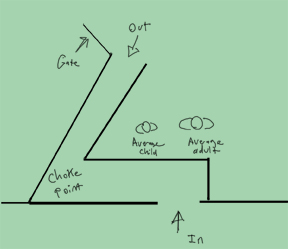
To enter the schoolyard, people must enter the opening in the fence, make an immediate ninety-degree turn to their left, walk down about three feet, then make a roughly one hundred and thirty-five degree turn to the left at the point where the passageway narrows. They then walk the remaining four feet or so, through the opening into the schoolyard (which can be secured with a gate). Reverse the process to exit. This causes all traffic through either of the two back entrances to be single-file. It is also meant to be variably unidirectional… people are not only moving single-file, but ideally, all in the same direction.
I suppose it’s a safety and security thing. I, personally, can imagine a few instances where it might cause a difficulty if people could only travel through these entrances, such as an emergency and/or disaster. That’s the arrangement we’re given, though. Entrance and exit through the front of the school is substantially easier, just some wide gates in chain-link.
A number of parents arrive early to the school for pick-up; the gate opens about five to ten minutes before school closes, so parents can (if they choose) go to their kid’s classrooms to escort them out. I did this myself for a few years, until Andrew was in the second grade. Now, I wait outside the gate for him to come out. When the school bell rings, kids and adults come wandering across the sports field to form a single file line for exit.
Then, some adult shows up late to go inside to escort their child out. Mind you, the times that people are let in, and that school lets out, rarely changes. You know… people can be late for all kinds of reasons. Bad traffic. Some item of work that had to be finished. Whatever… I’ve been late myself. Traffic through the back entrance is a) single-file and b) unidirectional. There are parents waiting outside the gate, who DID arrive on time, for their children to exit. Ideally, a late-comer will have to wait until there is a lull in the exit line, or the majority of people have left, to get into the schoolyard. This wouldn’t be a rant if that’s how they did it, though, now would it?
No… they cram themselves into the entrance, which is mostly occupied by elementary school children who want to get out of school. It’s like a salmon trying to swim up a salmon-sized pipe with salmon pouring out of it. The kids try to work their way around the adult, the adult tries to shove through the kids and everything… slows… down. The line of people needing to get out (if there was a line to begin with at all) grows. It’s only seven feet of grassy path, defined by chain-link and poles, but it turns into some kind of horror movie maze.
If people are lucky, someone (usually a kid) who hasn’t started through the inner gate will stop, and back up a little, and let the adult through.
So, it’s a little longer that everyone has to wait. For most, just an inconvenience. I’ll admit to being a little more sensitive to the situation than that. I have three herniated discs in my spine, and there are no seats within waiting distance of that back entrance. A few minutes of wait here and there are fine, but when this happens twice or more in a day, I’m in some considerable distress. It takes my son long enough to work his way from a classroom at the front of the school to an exit at the back as it is. Waiting for people who think nothing of inconveniencing everyone else isn’t high on my list of acceptable reasons to be in pain.
There’s another thing that happens, though, and it really enrages me.
Say some kid makes it outside, but there’s a problem. They forgot a vital piece of homework. Some other kid throws their shoe back over the fence. For whatever reason, a kid needs to get back inside, while there are other kids pouring out.
I’m a lot more tolerant of a kid having to get back inside than I am of an adult who showed up late. Andrew’s been that kid a couple of times, probably because I used to be that kid all the time. That might be an emergency, or at the very least something important. So, the kid plunges back into the rush of people out.
Working around the other kids is one thing… kids move through kids a little better than an adult moves through kids. Then, they encounter one of the adults that’s coming out.
Look… I know that adults have places to go and things to do. I know that the adult probably doesn’t want to be in that schoolyard any more than their kid does. I understand these things. What I can’t understand is an adult, a parent for Pete’s sake, seeing a distressed child trying to get back into the school, and forcing themselves past that child. If the adult has reached the choke point, there’s a chance to tell people behind them to back up a little and let the kid through. If the adult has only just gotten through the inner gate ( I saw this happen right in front of me, today), they can certainly back up a step and let the kid in, rather than push them all the way back out.
(So Angry I Used Ranty Twice!)
Bad enough if this is how you treat another adult. That’s being a dick, which isn’t even frowned upon in some circles. Bad enough if this is how you treat a child when you’re out alone; don’t do that, though, or you might force some right-minded individual to risk jail time by punching you clean in the nose. No, the worst part is that the adults at the school are acting like this in front of their own children.
(Pause again. Think about bunnies. Make blood pressure go down.)
You know, I was raised in a loving household, and I had a solid background in the basics. Sesame Street. Davey and Goliath. Speed Racer. I went to Sunday School (where I was frequently told I was making God cry), and I absorbed a lot of lessons from puppets and cartoons. Some of it doesn’t make sense to this day, but some of it seems like something too important to miss.
My parents, grandparents, and other family reinforced these basics lessons. They were all about treating people right. It wasn’t even about being a Christian… it was about being a person.
Follow the rules; they are there for your safety. Take turns. Help people. If a person needs a kindness that you can provide with a simple minute of patience, that’s a minute well-spent. Treat other people the way you want to be treated yourself. Am I crazy? Are these really hard? Shouldn’t I be teaching these to my son before I teach him “never draw to an inside straight?”
I’m deeply concerned for the state of civility in our civilization, right now. I can see civility draining away in our popular culture, our news media, our political discourse, our philosophical musings, and right there at the back entrance of my son’s school… and it makes me want to do some very un-civil things.
Tranquilizer rifles and tattoo guns are both hard to find, however, so at least there’s that.
 Matters of deCorum