Vlog 002 – What is a Roleplaying Game?

It’s addressed in just about every Roleplaying Game out there, but I felt like giving it a little a little bit more depth than it usually sees. It gets a little personal.
What do you think? Please comment!
The First Vlog Post; Lightsaber Nunchuks

So, are Lightsaber Nunchaku a bad idea? Let’s explore, shall we?
What do you think? Agree? Disagree? Comment, and let me know!
The “Matters of DeCorum” Video Blog Trailer!

So, I really want to do a “weekly” video blog; I LIKE the idea of putting myself out there in a more engaging manner. SO, I put together a trailer (on the assumption that if I can put together a trailer, I can put together a Vlog). Here’s that trailer; what do you all think?
I have a few weeks’ worth of subjects in my head; suggestions are always welcome!
So, 2015, We Finally Meet

Well, THAT’s a combination you don’t see every day… conversational Scott, RPG Scott, and Political Scott… oh, right. It’s almost 2015.
And when I say almost 2015, I mean that, as I write this, we are in the very last hours of 2014 AD. At midnight, the world becomes the Earth of 2015, which I’ve been writing about since 2007 when we published Hot Chicks: The Roleplaying Game. I figured it was time to look at the dystopian future that I envisioned with my partner Victor Gipson and see how it compares to the world that I’m about to set foot into.
It’s an interesting comparison, as it turns out.
First of all, the elephant in the room; I don’t think there are actual aliens or demons wandering the surface of the Earth. That’s kind of nice, actually… those guys suck. There aren’t robots and ninjas jumping out of the shadows to abduct valuable humans and use them as products and food in off-world markets…well, not that I’ve noticed.
I don’t seem to have developed any magical powers, Martial Artists still need actual wires to perform “Wire-Fu,” and we’re not yet transferring human intellects into computers and using them to drive android bodies. I kind of hope that last one happens pretty soon, though. At the very least, I’d like to be able to go to a clinic and get a Kevlar-laminated Titanium Spine.
Hot Chicks: The Roleplaying Game describes a fantasy world, after all. An urban fantasy world, to be sure, but a work of fiction. An envisioning of an alternate world where these things are all a real and tangible possibility. I never expected demons and aliens to step out of the shadows and into mankind’s attention in 2015; that would be ridiculous.
That’s about two-thirds of the foes of mankind that I envisioned seven or eight years ago, though. The third one?
I totally undershot the mark on the third one. The third one is way worse than I could have pictured.
Along with abducting aliens and rampaging demons, I envisioned a world where human corporations were the biggest defilers of human dignity. Megalithic organizations which cared little or nothing for human life, insinuating themselves into our governments and making them one in the same.
From Hot Chicks: The Roleplaying Game (electronic edition, page 26):
“Regardless of the form of government, whether it be a Democracy, a Monarchy, a dictatorship, or what have you, all governments have a single critical flaw. They are all made up of people. Eventually, no matter how pure the intention in the formation of the government, power corrupts, and governments come to be run for the sake of the government itself, rather than its people.
Even if the governments goes through all the paces of appearing to be a representative government that puts the safety of its citizens first, they will conceal the most dangerous elements of the world from their populace to ‘prevent a public panic,’ ‘protect people from dangerous information,’ or to ‘keep the suckers in the dark so we can control them more effectively.’
The governments and political structures of 2015 are very similar to those of 2008, but they have dropped a lot of pretense. Democracies are controlled by special interest groups (mostly corporate) who offer financial compensation to government officials in exchange for votes and legislation that favors them over the public good. It never appears in the news (as the media is simply another group of corporations), but everyone knows it happens.
Elections are still held, but there is no longer any pretense that the majority actually chooses their leadership. The elections are huge media circuses where the outcome can be seen months in advance, but people still watch them to see the verbal blood and gore.”
When I wrote that, I was reaching for a feeling of a dystopian “Cyberpunk” style near-future. There were elements of the current (at the time) political climate in that vision, but also a deliberately cynical world-view used to paint a grim picture. It wasn’t the world that I actually saw, nor the world that I wanted to see. It was a world I wanted to run around in with super-powered characters, having running gun battles and kung-fu fights in malls and factories.
Let’s break it down into its component elements.
- Obviously corrupt individuals forming government.
- Repression of information.
- Overt influence by special interest groups and corporations.
- Elections are little more than overblown media circuses.
I kind of thought that I’d be doing something like this at this point in time, a few years ago. I never thought it would turn out quite the way it’s going to. I kind of knew things weren’t going to go well in these areas, but I was also kind of hopeful that wiser heads would prevail. This is what happens when an optimist designs a dystopia.
Obviously Corrupt Individuals Forming Government
Check. (Sigh). It may not be all of them, but the corruption is so easy to see that it’s painful. One need only ask the question “why” often enough when looking at legislation and other government action. As we enter 2015, big money in politics isn’t just a problem, it’s been institutionalized. With the Supreme Court’s decision in Citizen’s United, it has been declared that money equals speech and that corporations are, effectively, people, with the right to have their concerns addressed and to influence the political process through the expenditure of cash on campaigns. It’s totally out in the open; you want to have your way in America? Form a Political Action Committee (or better yet, your own Super PAC), gather financial resources with virtually no limit, and throw money at campaigns. There is little or no oversight, no accountability, and no transparency. Politicians can openly be purchased. Can we still really call it corruption if it’s the law, I wonder? Then again, can we still really call it a Democracy?
Repression of Information
Check. Granted, we’ve seen some pretty dark stuff released for public consumption; the senate report on CIA intelligence gathering post 9/11 comes to mind. On the other hand, if one was to try to find out, say, how many people were killed by police officers between 2008 and 2012, complete and uncontested data seems difficult to aggregate. Trade agreements (such as the Trans Pacific) are signed without much in the way of public perusal and comment, and legislation which can damage the function of our free information networks (like the one you’re using to read this) such as SOPA, while they are defeated by considerable public outcry, are then re-introduced quietly as portions of other bills and passed without comment.
Every promise of government transparency has been broken. The public receives a steady diet of terror and celebrities from the corporate news outlets, while a desperate few comedians try their hardest to show the world the truth. Even the release of information which is ruinous to the honor of our country and its former leadership can only provoke us to ask “if they’re showing us this, what are they hiding?”
Overt Influence by Special Interest Groups and Corporations
Check. I’ve covered this a little bit above, but this one is so significant and so damning that it deserves a little more attention. From the top levels of our government to its roots, the influence of Wall Street financial institutions can be seen. Many of the individuals within our government who are involved with policing the regulations on financial institutions worked for those financial institutions before they entered government, and will leave government to re-enter positions in financial institutions. Let me say that again another way for emphasis; the people in charge of the regulation of financial institutions are the people who most profit from the lack of regulation on financial institutions. I could not have imagined the magnitude of this “revolving door” in 2008, and I shouldn’t be able to see it so damn clearly now.
People who are involved with corporations that profit by damaging the environment have purchased representatives in our government who are ostensibly responsible for protecting the environment. People who make money by selling hardware to our military have purchased people within our government who are responsible for buying hardware for our military, which our military has flat-out stated it neither needs nor wants.
Scientific facts about the state of our world are routinely ignored where they might conflict with corporate profit; in fact, the people most qualified to speak to those scientific facts are effectively barred from sharing data with government agencies that most need to hear it. Global Warming? Why, it’s a hoax, don’t you know? Evolution? Get thee behind me, Satan!
Elections Are Little More than Overblown Media Circuses
I want to say “Check,” and I also really don’t. There are a lot of political indicators for how an election is going to go; one can determine, with high probability, the outcome some time in advance of an election. Do the votes count?
That’s the one that gets me. “Predicted” isn’t the same as “Predetermined.” There’s still a contest, there, and for some reason, they still seem to need votes. Or rather, they need the right votes. Voter suppression seems to be a huge issue these days, and it is. One wouldn’t need to engage in voter suppression if the votes didn’t matter, though, would they? Some people in power are afraid of large voter turnout.
Campaigns are purchased by the amount of money that is pumped into campaign advertising, and the side that spends more often gets more votes. That’s advertising, though. They still need to win hearts and minds on election day; otherwise, if there was a way to just drop the money down and purchase a block of votes, they wouldn’t spend so much on the ads.
The United States may be turning into an Oligarchy (and, in fact, may argue that it already has), but the government still seems to need votes. Elections matter.
Even in these days where the government and its agents (whether agents of the intelligence agencies or even the police) seem to be engaged in an all-out conflict with the American people, the people and their votes appear to matter.
There ARE hundreds of millions of us, after all.
I know, I know… all of this is far more complicated than the light coverage I’m giving it, there are hundreds of factors I haven’t addressed, and “you’re a liberal hippie, Scott.” (Actually, I’m a moderate progressive, which makes all of this kind of more frightening).
In many ways, the government/corporate influences that I described as the background of the Earth in 2015 are a lot lighter and friendlier than 2015 is actually looking like. On the other hand, there’s still that spark of optimism in me. People can and do make a difference. Regardless of anyone’s political leanings, everyone does make a difference.
This year, we advance the timeline of Hot Chicks to our new setting for the Victory System, “Destiny 2025.” The modern political climate will obviously color my view of that world as I write it into its own dystopian nightmare, and in ten years, I hope to do a similar retrospective comparison.
In the meantime, my hopes for the next year and the years to follow, for myself and for all of us. Let us keep our eyes open; let us question everything with a consistent and objective world-view. Let us stay informed by using the sources of information that we like and more importantly, those we don’t. Let us ask ourselves if we are researching the facts or confirming our bias. Let us make our decisions with wisdom, compassion, and a brutal insistence that tomorrow belongs to our children.
And I totally need to hit the gym on a more regular basis. Have a Happy 2015, everyone, and let’s aim for a happier 2016.
The Most Disgusting Three-Word Phrase Ever

Both Political Scott AND Ranty Scott at the top of the post. Fair warning given.
“Disgusting. Adjective. 1. causing disgust; offensive to the physical, moral, or aesthetic taste.”
Dictionary.com is my friend.
Now, I’m a proponent of free speech. I think that censorship is one of the great sins, so far be it from me to tell people what they should and shouldn’t say, or what words that they should or shouldn’t use. Language is a playground, after all. I like me some off-color humor from time to time (that is, all the time) and I can hold entire conversations in innuendo. Heck, I even like puns.
There is a phrase that has been going around the internet over the past few days, though… a three-word phrase that has managed to earn a rating of “disgusting” from me. That’s not easy… that’s REALLY not easy. While I generally try to be inoffensive, I also try not to be too offended if I can help it. It takes a LOT to push me over the edge into “unsettled” territory, and a lot more to push me into “disgusted.” This phrase has done it, though. The phrase?
“Defense of torture.”
For clarity and to mark the events which bring this about, a little current events. After the events of September 11, 2001, the United States took actions to determine who was responsible for the terrorist attacks on American soil. More, they set out to get early warning for possible future attacks, and to dismantle the networks of individuals and organizations that were determined to do harm to the United States of America and Americans. How well this effort has succeeded at this point in time is up for some interpretation; we found and terminated the man most responsible for the attacks, Osama bin Ladin, but in the wake of our efforts there is a vastly destabilized geopolitical situation and whole new organizations of ever-increasing size set to oppose us.
A recently released report on Intelligence activities conducted by the United States during these operations states quite clearly that, in our pursuit of intelligence about our enemies, we tortured people.
I say “we” because these operations were performed by operatives of the United States of America in pursuit of the interests and defense of the United States of America. I participate in the electoral process and enjoy the benefits of citizenship of the United States, so whether my guy wins or not, I’m a part of it. Every American is, like it or not. I can have no personal pride in my country if I do not also admit its faults personally. Like this one.
At the time, what little we knew about these activities were hidden behind the euphemism of “enhanced interrogation.” This is the technique known as “doublespeak,” as it was described in George Orwell’s novel “1984.” You can call something by a flowery descriptive term and intellectually distance yourself from it, like calling torture “enhanced interrogation,” or calling dying “becoming metabolically challenged,” or calling a softball bat a “lower cranial impact enhancement device.”
What was being done, however, was most definitely torture.
“Torture. Noun.
1. the act of inflicting excruciating pain, as punishment or revenge, as a means of getting a confession or information, or for sheer cruelty.
2. a method of inflicting such pain.
3. Often, tortures. the pain or suffering caused or undergone.
4. extreme anguish of body or mind; agony.
5. a cause of severe pain or anguish.”
Again, Dictionary.com comes to my aid. Sounds unpleasant, doesn’t it? It kind of is. By necessity, engaging in this activity results in unpleasantness. It is a practice that is widely reviled, so much so that the United States of America has participated in the signing of numerous international treaties, conventions, and other agreements that state we won’t participate in this activity. You know… this activity that we just participated in.
Torture is such a reviled practice that we, as a nation, have used it as justification for entering into war. When some despot is known to engage in the act of torture, they must be stopped. When looking back in history on the qualities of the most vile and egregious of perpetrators of evil, torture is among the first of their crimes listed. We know Hitler was responsible for torture, because torture is that crime of his that is constantly trotted out right next to genocide. Stalin? Torturer. Saddam Hussein? He tortured his people.
And so did we.
We tortured people who were guilty of acting against us, and we tortured people who were completely innocent of any crime. We tortured innocent people. One of these innocent people perished from the process. We tortured an innocent man to death.
Wow. It’s not often that I have to stop in the middle of one of these to calm myself down a little bit.
There’s something I have to say about the process of torture. It’s kind of important, and while others are saying it, I have a pithy blog and i feel the need to state this once more.
As a method of gaining information, torture is mostly ineffective. This isn’t a new area of information, this isn’t some grand revelation. Torture isn’t a new field of study by any stretch of the imagination. Torture rarely gives the torturer the information that they are trying to acquire in any accurate form. When someone is tortured, they develop a tremendous urge to make the torture stop. The torturer usually believes that their victim will give them the desired information as a condition of stopping the torture. It makes a certain kind of sense; “I want something from you, so I will cause you tremendous discomfort until you give it to me. When you give it to me, I will stop causing you tremendous discomfort.”
The problem is that the victim in this situation will tell the torturer what the victim believes the torturer most wants to hear. Even in our popular literature where this occurs, the victim will say “I’ll tell you anything you want.” Note that this statement is qualitatively different from “I’ll tell you the absolute truth.”
So, not only have we used reviled methods, which help to define “evil” in the national consciousness, but in all likelihood these methods were ineffective. The senate report on the CIA’s activities in this area concluded that the “enhanced interrogations” did not yield any accurate information that was not also acquired using less questionable methods. Even the director of the CIA at the time, in his rebuttal, has stated that there’s no way of knowing whether or not the information gained was actually useful or usable.
The worst part? All of these studies were available at the time of the operation. There were operatives with decades of experience in intelligence gathering who knew that torture was, at best, an unreliable method of data acquisition. We were well able to know at the time that these methods would be ineffective, and we still used them.
So, I’m going to go up to a statement that I made earlier (which upset me to type) and add two words to it.
We tortured an innocent man to death for nothing.
So, with that context firmly in place, let’s return to the most disgusting three-word phrase ever.
“Defense of torture.”
There are those who believe that the methods used were justified and, in some cases, laudable. That the people who performed torture in the interests of our national security were patriots and heroes, doing what absolutely had to be done in order to save American lives.
After all, what’s a little torture if it means defending our way of life, right?
You know, even little evil Scott in the back of my head isn’t going to play devil’s advocate on this one. So, I’ll list a few of the common defenses and then eviscerate them.
Those techniques weren’t actually “torture”
I’ve seen a number of pundits, in their defense of these techniques, say that they’d be willing to undergo a few of these techniques just to prove that they’re not actually “torture.” Sean Hannity of Fox News said that he’d be willing to be waterboarded to prove that it isn’t such a big thing. He said that a couple of years ago, but he has yet to undergo the process. Interesting. I DO have another video you can watch on the matter, though. Writer Christopher Hitchens (1949-2011) agreed to undergo the process under close observation by trained CIA interrogators. Click Here To Have A Look and determine for yourself whether or not the technique is “torture.”
Experts in the field say that these techniques are torture; people trying to defend the practices say they aren’t… tell you what. Anyone who wants to claim that the techniques used in these “enhanced interrogation” sessions who claim that they aren’t actually damaging or tortuous can easily convince me that they are correct by being subjected to those techniques themselves while being recorded on video. Hey, that sounds like a great idea! All these people who are saying that these techniques weren’t that bad? They can quickly and easily prove their point by subjecting themselves to these techniques while being recorded so the whole world can see that they simply aren’t that bad! That would immediately and decisively settle all of these arguments once and for all. I wonder why none of them have done it yet?
(I don’t actually wonder why they haven’t done it yet. It’s because they don’t want to be tortured).
We didn’t torture all that many people
How many people do you have to torture for this to be a problem? How many minds have to be shattered, families destroyed, unmarked graves dug? I mean, would it matter if we just tortured one guy? I mean, for the good of everyone in the country, just one guy? That wouldn’t be so bad. It’s just one guy. So, just one more, right? I mean, the first guy gave us a name. We need just one more, just to make sure.
No. Not one. Not one person. Morally, ethically, legally, TACTICALLY we can’t subject just one person to torture. One, it’s wrong. It’s fundamentally wrong. Two, it’s ineffective. It doesn’t work. There is no return on the investment of our collective national soul. The act of torture is the route to moral bankruptcy.
It was in the interest of saving American lives.
It failed. It failed in massive, huge gobs of “LOSE.” Not ONLY did it fail to turn up any information that was actually useful in the preservation of American lives or interests, but (arguably) our practices in the Middle-East during this time created more terrorists than there were when we arrived. Black-bagging husbands, brothers, fathers, and sons who are taken away never to be seen again, or to be seen again in an indeterminate time but as ruined shells of the men they had been, is a tremendous recruitment effort for the other side.
If there’s a nuclear bomb in Los Angeles that’s going to go off in forty-eight hours, and you have the guy who knows where it is, of course your’e going to torture him to find it
I write role-playing games for a living and even I think that’s far-fetched. So, you know that there’s a bomb. And you know what city it’s in. And you know when it’s going to go off. If you need more information than that, you’re going to have to fire someone in your intelligence agency. What’s more, you’ve got the guy who knows. So, you can try to torture the information out of him, remembering that most of the techniques used by the CIA took far longer than two days to accomplish. More, the guy just needs to give you one or two bad leads to spread your forces unbearably thin and totally screw any efforts you could make to find the bomb conventionally. And, of course, you’re torturing the guy rather than finding his known acquaintances, following his tracks for the previous week, looking at his travel itineraries, and doing all of those other things that competent Intelligence operatives have been doing for decades without resorting to torture.
Neither the Constitution nor the Bill of Rights specifically states that we can’t torture people, so long as they haven’t been tried of a crime and aren’t technically being punished
And THAT one, my readers is straight from Supreme Court Justice Antonin Scalia. It’s true, while people are protected from cruel and unusual punishment, technically these people couldn’t have been being punished, because they hadn’t been tried for a crime and convicted. Let that logic sink in for a moment, and ask yourself who, exactly, is protected by that reasoning? If you answered “no one,” you’d be incorrect… in fact, that reasoning protects torturers! That must be what the founding fathers meant…
Oh, wait. George Washington was one of the founding fathers, right? I mean technically, yes? So, what did he have to say on the practice of torture in wartime?
“Should any American soldier be so base and infamous as to injure any [prisoner]. . . I do most earnestly enjoin you to bring him to such severe and exemplary punishment as the enormity of the crime may require. Should it extend to death itself, it will not be disproportional to its guilt at such a time and in such a cause… for by such conduct they bring shame, disgrace and ruin to themselves and their country.” – George Washington, charge to the Northern Expeditionary Force, Sept. 14, 1775
Of course, that was talking about prisoners of war, not “enemy combatants” or “persons of interest.” So, if anyone out there can find me a quote where Washington said “Oh, wait, they’re not prisoners of war? F*ck those guys, then,” I’d appreciate it.
So, yeah.
Jesus would support the use of torture
This according to Bryan Fischer of the American Family Association. To this, I can only reply…
“Hello, Mister Fisher? Hi, this is the brand manager for Christianity. I’m going to have to insist that you stop using the name of Christ in any defense of any practice that brings harm to any human being or humanity; our Lord and Savior IS the ‘Prince of Peace,’ ‘Wonderful Counselor,’ and ‘the Great Healer,’ after all, and has never advocated for any form of torture whatsoever. In fact, he advocated for a completely opposite course of action in any and all circumstances. If you choose to ignore this polite request, we will have no choice but to pursue legal recourse and, of course, you’re going to burn in Hell for all eternity, but that goes without saying. Have a nice day!”
Those who were tortured weren’t American Citizens
The treaties we have signed and the laws of our land prevent us from treating foreign nationals, in our country or in any other, the way the victims of torture were treated. That’s the legal response. Morally and ethically? What does it matter where they’re from, where they were born, or anything else about them other than the fact that they are living, breathing, thinking, and feeling human beings? The act of torture is reprehensible no matter who the victim is. It’s a violation of the basic human rights that we, as a nation, have signed to an understanding of.
But the countries where we tortured people aren’t signatories of the treaties calling for an absence of torture
So? Have you not been listening? We have agreed on every occasion possible to restrain from the use of torture because torture is both bad and wrong. As in the movie “Kung Pao, Enter the Fist,” we may actually need a word that reflects something that is worse than being both Bad and Wrong, and say that torture is “Badong.” Or, more seriously, that torture is one of the most objective measurements of the presence of evil itself that we have in this world. We don’t abstain from the use of torture because it’s an agreement that prevents our troops from being tortured; we abstain from the use of torture because torture is objectively wrong.
And that’s the thing of it. Torture is one of those things that is objectively wrong. It causes a human being to suffer and perhaps to die, for little or no gain of reliable tactical intelligence (or worse, faulty intelligence that will lead to tactical disadvantage). The only thing torture can be successfully used for is to slake a thirst for vengeance or to satisfy a requirement for sadistic pleasure, neither of which are measured as “good” things. Torture is in and of itself an injustice, and as such it can not serve justice.
So, yeah. “Defense of torture.” Have we descended so far into moral bankruptcy as a nation that this is even a conversation we need to have? Is this really a debate, or am I in some kind of nightmare? I do suffer from Sleep Terror Disorder, after all, and it’s possible that I’m dreaming this and can’t wake up from it.
That would be a horrible thing, all right. But it wouldn’t be torture.
I can’t hold it in any longer… Goldfinger was a TERRIBLE Villain
I haven’t posted for a while; that’s mostly because I’ve taken on an insane publishing schedule and I’ve been working WAY too hard. But it’s time I got something off my chest.
Auric Goldfinger was a TERRIBLE villain.
It’s not really topical, it’s kind of out of the blue, but every time I hear someone reference Goldfinger, it stabs me in the back of the brain.
The eponymous villain from the movie Goldfinger (I can’t speak to the novelization as I haven’t yet gotten to that part of my reading list yet) was supposedly a typical Bond super-genius. He had massive amounts of resources, a keen intellect, access to military-grade materials, and alliances with both organized crime and the Chinese government. In general, he had a plan with a huge scope.
That plan? To detonate a nuclear device in the middle of Fort Knox, rendering the entire U.S. Gold reserve radioactive and thereby vastly increasing the value of his own massive stocks of gold. If successful, it would have made him one of the most potent financial powers on the planet.
Which would have been a tragedy, because Goldfinger was HORRIBLE with money. Seriously.
I will point out, as my evidence, the single most wasteful bucket of spending that any super-villain has EVER gone to, in any medium, of all time.
Goldfinger has, at great expense, gathered the top bosses of all the crime families who have been helping him acquire resources; they meet in a massive room in his ranch house. Having gathered them, he shows them his plan.
He shows them with a scale model of Fort Knox (and a BIG scale, at that) complete with lights to display the flight paths of the aircraft carrying the nerve gas that will knock out all opposition. The model itself must be fifteen or twenty feet across… it’s HUGE. The practical effects for the assault on the Death Star used models smaller than this. There’s an elaborate control panel which manages all of the lights, sound-effects, the environmental controls of the room; everything. And how does he do the reveal? Is there a curtain or a sheet to pull aside, or is it just in the dark until he turns on the lights?
No. It’s on a HUGE hydraulic lift platform. Controlled from the control panel.
It’s all well-finished, lots of wood paneling and brass. The reveal platform for the model and lift must be made of steel, custom designed, properly ventilated (so Bond can overhear the plan, of course). The model itself, exquisite in detail, must have been made by a professional architect and a few electricians, none of whom would have worked cheap. Then there’s the control wiring, the hydraulics, the cabling for all of the power required, the extra lighting in the room, the speakers and sound system…
At the time Goldfinger was made, you could buy a lovely two-story house for what this “plan reveal” scheme must have cost… and had enough left over for a four-door sedan and all of the kitchen appliances. For TWO HOUSES.
So, Goldfinger pays the mobsters a huge amount, in gold, to show up to the meeting. Each of them. “Here, have a bucket of money, show up to my meeting.” These are the heads of crime families and organized syndicates; they’re not getting out of bed for less than seven figures.
He gathers them in his “plan reveal” room. He spends all of five minutes telling them his plan. And then?
He kills them all.
He doesn’t just kill them; he pushes a button and the room fills with nerve gas.
“But Scott,” my evil second voice says, “surely that was the most expedient way to make sure none of the gangsters revealed any details about their previous dealings with Goldfinger; he had to assure that they couldn’t talk!”
Granted. But… OK. Canisters of nerve gas – SUPER expensive, as he had to pay a lot of gangsters and officials to get a hold of it. A secondary ventilation system; ducting, outlets, a system of fans – expensive, but nothing compared to the system that would safely vent the gas OUT once everyone was dead. It could have been the same system with the fans reversed, but there had to be some ruthlessly efficient military scrubbers and decontamination in the system, because you can’t just pump the nerve gas outside to get rid of it. Expensive.
When you think of a super-villain making a plan to become a financial power, if not THE financial power, one would like to think of a transparent green sun-shade over their eyes while they work away at sums with a slide-rule and a mechanical calculator, drawing blueprints and quietly smiling to themselves as they achieve a perfection of strategy.
I’m sorry, but when I look at the “reveal my plan to the mobsters” scene in Goldfinger, I can only imagine him pleasuring himself using the boiled-down fat of an endangered species as lubricant saying “How… HOW can I make it cost MORE?”
“But Scott,” my evil voice says, “how else could he have made absolutely sure that the mobsters wouldn’t talk?”
Me? If I’m a Bond villain?
Auric Goldfinger fairly obviously spent more than a million dollars a head on his “mobster elimination” plan. Hell, he may have spent up to a million apiece just getting them there, before you even consider the Plan Reveal machinery and Nerve Gas delivery system.
I would have hired Scaramanga – the man with the golden gun – to hit each of the mobsters involved. One million dollars a head, delivery assured. It would have been cheaper to hire another Bond villain to kill the mobsters, probably by an order of magnitude, than it would have been to use Goldfinger’s method.
Every single moment of Goldfinger’s plan was oozing with excess. “We need to point the laser at the door of Fort Knox? Well, we COULD just open the back door of the truck that it’s in, OR we could have a massively complicated hydraulic lift bring the laser up through a hinged roof!”
I suppose that the idea was that Goldfinger had SO much money that he could throw it around without a thought for how much he was spending. “Oddjob, take the head off of that exquisite and unique marble statue to make a point to this guy that I just met. It’s my club, so I’ll just buy myself another exquisite and unique marble statue to replace it.”
It’s not that I demand that my villains be thrifty, exactly, but they should have SOME sort of self-control.
“But Scott,” says my evil back-y-head voice, “what about the whole ‘No, Mister Bond, I expect you to die,'” bit? Surely, that was the most bad-ass thing a villain ever said to Bond!
True. But his follow-through was TERRIBLE.
Goldfinger has Bond tied down to a table and decides to kill him by slowly cutting him from crotch to crown with a laser beam. Ok… laser beams are cool. Overly-elaborate deathtraps with ample time for countermeasures and escape are a Bond villain staple, can’t say much about that I suppose… except the situation itself is another exercise in Goldfinger’s excess.
“A bullet costs only a few cents, but the electricity to operate this laser will cost more than all of the ammunition in Montana! Plus which, I own a f*cking laser… what’s the point of owning a f*cking laser if I can’t cut secret agents in half with it!?”
So, Bond has time to yell out the one phrase he picked up from his rambling around Goldfinger’s ranch. Goldfinger, to his credit, suggests that it was a random phrase that Bond could have picked up from anywhere. Bond retorts with “can you really take that chance?”
Goldfinger goes to talk it over with the laser operator. The deathtrap is so slow that Goldfinger could have ordered a pizza or gone out to a movie or something, but he elects to stop the laser.
After which, he has Bond tied at the wrists and takes him EVERYWHERE HE NEEDED TO GO IN ORDER TO STOP GOLDFINGER’S PLAN.
“Oh, you might have told someone everything about my plan? Well, I’ll just carry on as though that possibility doesn’t exist, and bring you along in case you want to kill my henchman and turn off the bomb or something.”
What would I have done, as a Bond villain?
“No, I can’t afford to take that chance,” I would say. “So, I’m only going to cut your left testicle in half with this laser. No, no, don’t say anything yet. After I’ve lasered your left nut in two, I’ll give you a chance to tell me everything you actually know, and who you have actually talked to about this. If your answers are unsatisfactory, I will laser off other parts of your body until your answers are satisfactory. Did I mention I have a f*cking laser?”
I mean, what was Goldfinger’s deal, exactly? “I’ll give you the most tortuous, expensive death I can imagine, but I wouldn’t THINK to torture this key and vital information out of you with my very expensive equipment. Unless it was more expensive that way, maybe. Maybe I can find a more expensive way to torture you! Or, Sodium Pentothal. That’s expensive, right? But seriously, who have you told my plans to?”
The fact that he was ultimately defeated by a one-person internal security error (facilitated by letting Bond live and not restricting him from interacting with Goldfinger’s staff in any substantial way) shows how shaky the whole plan was from the start. Heck, it almost makes one wonder exactly what Goldfinger would have done with the power he’d have gotten if it all worked!
“Now that I am the greatest financial power in the world, you will do as I say! You will remove the government regulations on financial institutions and investments, you will permit money itself to be used as political speech, and permit the wealthiest individuals within society to mandate policy to increase their personal stores of wealth while negating any requirement that they return any wealth whatsoever to society!”
Well, Ok. I have to admit, even Goldfinger wouldn’t be THAT stupid.
The ALS Ice Bucket Challenge and Negativity… a Rant Thereupon
Hello, Ranty! I suppose this has to be an angry post, then. Well, so be it.
By now, there is VERY little chance you haven’t heard about the ALS “Ice Bucket” challenge. This viral phenomena, which benefits the ALS Association which strives to vanquish Lou Gehrig’s Disease, has gained an incredible amount of attention.
(No, I haven’t been nominated to take the challenge yet. Still, Click Here to visit the ALS Association’s website and consider donating anyway).
Here’s how it works in a nutshell (as I understand it). Someone posts a video of themselves dumping a bucket of ice water over their head (or having one dumped over their head). They nominate three people who then, by honor, have twenty-four hours to either donate $100.00 to the ALS Association or to dump a bucket of ice water over their own head and nominate three other people.
To date, it has raised over ninety-million dollars for the ALS Association and raised awareness of the disease and its effect by an incredible amount. It has been taken and completed by internet personalities, celebrities, and people from all across the spectrum of human endeavor.
Anger starts now.
As with just about anything that becomes popular and/or successful on the Internet, a wave a nay-sayers has begun to step forward, decrying the Ice Bucket challenge for a number of reasons. I’ll address the reasons specifically in a moment; I need to address this reaction as a whole first.
Are you F*CKING serious? Honestly? A few years ago, it was “changing your Facebook Icon to a Cartoon Character is USELESS… STOP engaging in Slacktivism and MAKE a DIFFERENCE!” Well, THIS is what we might call “a difference!” This is how you propagate the needs of a charity correctly, with a popular appeal and a call to action! The ALS Association is looking at donations more than four times what they received only a year ago, there is a HUGE public awareness of the disease and its effects, and the internet negativity community STILL wants to take their collective self-absorbed dump on the effort? SHUT the F*CK UP.
To address this more specifically, I need to go over some of the arguments being made in opposition to an incredibly successful public charity effort. (Do you also find it sad that I had to type that sentence? I know I did).
“73% of the money is misappropriated by the Charity in question, so stop doing this.”
This statement is false. It has been addressed fully and completely by Politifact.com, Click Here for their excellent coverage of it. That a falsehood should be held up as an incentive to stop participating in the challenge is entirely unsurprising. In the above-mentioned “Replace your FB Icon with a Cartoon Character” effort to raise awareness of child abuse, a number of sources started spreading the falsehood that the effort secretly supported pedophiles in their efforts to lure children. When something becomes very popular and gains a lot of attention, those who have little or nothing to add to the effort can still gain attention for themselves by spreading a new and astounding “fact” that shocks and astounds those who have been in support of the effort. It must, of course, be negative, because that will gain the most attention. The ALS Association has a four-star rating, one of the highest available, when it comes to the management of donations to their cause; to malign them now with patent falsehoods is an obvious attempt to garner attention. (Note that I’m being relatively polite and not calling the falsehoods “LIES?” ‘Cause that’s how I roll).
“The Ice Bucket Challenge is Dangerous, so stop doing this.”
This statement is partially true. People have been injured in participating, there may have been a fatality. These are generally the results of people trying to “one up” another ice bucket challenge, scaling up the size of the bucket or its delivery method to ridiculous and potentially dangerous proportions. Ok, some of these have been pretty funny, but that doesn’t change the fact that there have been injuries. Now, when I see people taking an activity that isn’t inherently dangerous (like dumping ice water over your head) and ramping it up all Mythbusters style so that there are incredible and lethal forces involved, my first instinct is not to blame the charity they are trying to support. I might, however, say “hey, guys… are you certified to use that bulldozer?” Or I might remind someone that a pint is a pound, the world around, and that makes a single gallon of water eight pounds, and so standing under a ten gallon bucket of the stuff is standing under an eighty pound weight, so freakin’ BE CAREFUL. Urging some restraint and/or caution is entirely appropriate. Telling people to stop raising money for a charity because other people haven’t exercised restraint or caution is not appropriate. It isn’t a subtle difference.
“California is in the middle of a horrible drought, so stop doing this.”
Damn right we’re in the middle of a horrible drought. We’re losing ground water faster than Hamsters in a Herpetarium, and there’s little or no relief in sight. Personally, I’m expecting a VERY wet winter, but that’ll barely dent the problem we’re having. You know what else will barely dent the problem we’re having? Buckets of water being poured over people’s heads. Folks have been doing the challenge on their lawns, standing in kiddy pools, and in other places where the water isn’t “wasted.” Incidentally, when you live in a desert, dumping a bucket of ice-water over your head isn’t necessarily “wasteful…” sometimes it’s a bleeding survival tactic.
“I’m really tired of seeing the Ice Bucket Challenge all over the internet, so stop doing this.”
Thank you for your honesty! Now shut the f*ck up. People receiving a boost in funding and awareness for a horrible, debilitating disease trumps your internet viewing convenience. If you’ve somehow lost the ability to scroll past a video on Facebook, you should seek help. Like all fads, this one will pass… I’m surprised it’s still going as strong as it is, but I’m pleasantly surprised. The regular assortment of funny cats and vitriol will be back in a while.
“There are a lot of other charities that need money too, so stop doing this.”
This one gets me the most. This is the one that pisses me off to no end. “Your local charities probably handle the money better and they need your money too, so stop all this ice-bucket nonsense and give your money to other charities (likely charities that I, myself, would like to see support for).” You want the money to go to other charities? Here’s a clue… SOMEONE IS FINALLY DOING INTERNET ACTIVISM CORRECTLY. Someone has found the formula. It’s called the Ice-Bucket Challenge, and you’re hating on it. Find a simple activity with popular appeal. Present it publicly, call out people individually (perhaps popular or famous people with a good sense of humor and/or a good sense of charity), and add a call to action. Give out the website and the phone number. Plead for donations in lieu of participation, or inclusive of participation. Show us why you care about your cause, and freakin’ make me cry. Bring tears to my eyes with the suffering that needs to be alleviated, and show me that my participation in your cause can help to ease this suffering. Do NOT point to someone who is doing it right and bad-mouth them; that is low and petty and does NOTHING for your ’cause.
(Scott takes a deep breath)
Look, I get it. Negativity is easy. Looking at something that is popular and saying “I don’t like that” has become the easiest method for appearing intellectual ever. It isn’t new; knee-jerk resistance to popular ideas has been with us since fire and the wheel. We NEED a certain amount of that resistance in a society to prevent everyone from sliding down the intellectual slope into watching blinking pretty colors all day, but that’s when it’s done correctly. If you can support the negativity with facts or good reasoning; if you can be consistent in that reasoning and logic, and demonstrate a clear philosophy that displays how the negativity benefits social discourse, then GOOD! Tell me how much the stuff that I like sucks, I might agree with you.
Using negativity as a shortcut to the appearance of intellectualism leads to a number of negative effects. It can make you appear bitter rather than intellectual, or it may make it seem like you’re trying to whore for attention by being a contrary a$$hole. It might make you naysay a successful and honorable charitable effort on behalf of people suffering from a horrible disease for which there is currently no cure, and THAT would make me tell you to shut the f*ck up.
Just sayin’.
Free Motivational Pictures!
So, I’ve been practicing my Photoshop skills and being annoyed with things all at the same time. I’m not sure if that’s a good thing, actually; I think my annoyance is best kept in check and not publicly shared.
Pictures, though, are great… I LOVE sharing pictures! So, I’m kind of on the fence about this. I’m going to put these images here, then… I may put them up on other social media later on, but I’ll just put these here for now. If you would like to right-click and save a copy to share on social media, please feel free to go ahead. That is, if you think that these motivational pictures are motivating in the correct direction.
(Note: This post isn’t directed at any one person or any group of people, really… it’s directed at practices, not people. If anyone gets offended by these motivational pictures… well, I’ll let them speak for themselves at this point).
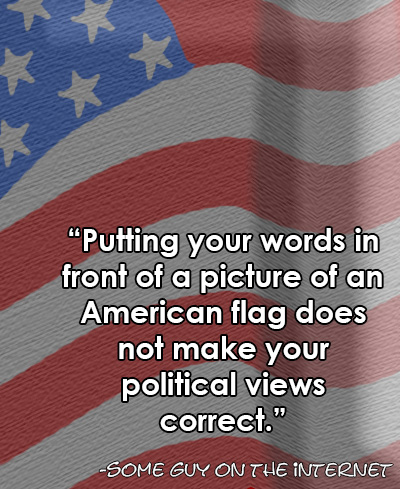
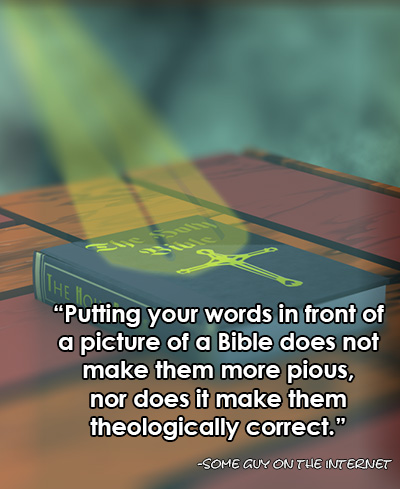
Use them wisely… use them in peace.
Namaste’!
On the Subject of Guns and Everything Else
We see a lot of tragic loss of life in our day and age. People are fragile things, like most stuff made out of meat. The deaths are many and varied; natural disasters, accidents, health problems, and acts of violence all take a number of human lives that is staggering to think about. Death happens; it is a constant companion to human existence. Jim Morrison of “The Doors” said it best, I think… “no one here gets out alive.”
When a tragic incident occurs, especially if news of it reaches the internet, there is an outpouring of emotions. These emotions are wide and varied, and usually run along lines of personal interests. The closer the incident is to you, either geographically or relationship-wise, the more affected one seems to be by it. If the incident carries some sort of political weight, then the gloves come off and everyone comes out swinging.
I don’t like to publicly jump to one side or the other of these incidents; they are incredibly polarizing and people’s views on them are deeply personal and incredibly important. We deal with tragedy through the lens of our beliefs, after all. That’s how we make it through, one at a time or in groups.
When these incidents focus on the use of firearms, no matter the human cost or sense of tragedy, things go very political very fast. There was a horrible incident just up the coast from me, in Santa Barbara, just a few days ago. Seven or more lives lost to one person with a firearm. Before the bodies were cold, people on both sides of the gun aisle were making sure their point was made in public forums… both those people in favor of some form of gun control, and those people against most forms of gun control.
There’s something that keeps getting brought up. I feel compelled to say something about it each and every time, and I keep telling myself “no, stay neutral. These feelings run deep and you’re unlikely to change any minds.”
Not this time. I’ve got a damn blog. I’m going to bleeding well use it. Note that the “Political Scott” icon is missing from the top of this post; that’s “merely conversational Scott” up there. Heck, it isn’t even “Ranty Scott.” No, I’m not going to say anything along party lines. I’m merely going to address one argument that gets made time and time again. In the future, when this argument is invariably made, I will simply direct back to this post. Here we go.
No, a knife is not equivalent to a gun. Nor is a hammer, nor are someone’s well-trained hands. No, someone is not going to do as much damage with any other weapon as they are with a gun.
Firearms are not equivalent to anything else. They are one of a few special cases in the history of invention. They are strictly and solely weapons.
People who want to defend the right to own firearms often attempt to make this equivalency. “If he hadn’t of had a gun, he would have killed just as many people with a knife. Or a hammer. Therefore, there is no reason to limit the use of guns.”
To which I must respectfully say “Bullsh*t.”
One: A firearm is a uni-tasker. It has one job; to do damage at range. That’s it. It is a purely destructive tool. I understand that it can be used, in practice, to increase one’s hand-eye coordination, but that is by continually doing damage down range. It can be used for self-defense… by doing damage down range. You can’t cook with it, you can’t build a bridge with it, and if you’re using it to drive nails, you shouldn’t have one to begin with. One purpose, one use.
A knife is one of the first, simplest, and most basic tools that humankind has ever developed. It does damage, close-up or down range. It cleans and prepares animals that have been killed so that they can be used for food and/or clothing, as well as preparing other parts of them to also be used as tools. It can be used to prepare food, to perform medical procedures, to shape wood, and a hundred other things. And while it can be used to do damage, it is far less efficient at doing damage than a firearm. A few knife-wounds are often survivable. A few gun shots are often not.
A hammer can be used to bash someone’s brains out, or it can be used to build a house. Multi-tasker. Less efficient at doing damage than a firearm.
Your average rock is a better multi-tasker than your average firearm.
Comparing firearms to any other item ignores the facts that a) other items have uses besides doing damage, while a firearm does not and b) other items are generally far less efficient at doing damage than a firearm is.
Two: If a knife or hammer is as dangerous as a firearm, why would you spend so much money on the more expensive firearm and not have a knife and/or a hammer? Hell, you can buy a sack full of hammers for what a good gun costs. If the knife or hammer is just as bad, it should also be just as good. There’s no reason to complain about the risks of gun control if you can still have a knife or hammer; if the psychotic with the pistol would have done as much damage with a knife, than why not just have a knife?
No… people worry about losing access to firearms specifically because they are more effective and more efficient at their one purpose – doing damage – than knives and hammers. Hence, the immediate, knee-jerk claim that gun ownership should be protected because other items are equally as dangerous is a simple false equivalency. No, they’re not.
(Pause for another sip of coffee).
Now, this is not to say that I think that the ownership of firearms should be limited. Actually, I think that people should be able to own just about anything they want, so long as they use it responsibly. Cars are actually capable of doing a lot more damage than a firearm (although far less often). I don’t think people shouldn’t be able to own cars, but I DO think that they should be required to use them responsibly. Same with firearms. Here is an item that is good for one purpose; doing damage down range. Can you use this item responsibly? Then here you go. Did you use it irresponsibly? Then you probably shouldn’t have one.
All of which is more common sense than anything else, I would think.
I’m not saying, in this post, that I don’t think people should own guns. By all accurate accounts, despite the fact that the REPORTING of gun violence has increased in the United States, the actual INCIDENTS of gun violence have dropped. I guess that says as much about using the Media responsibly as using guns responsibly, because the Media has been used pretty damn recklessly lately. A lot of people I consider close friends are either gun owners or support gun ownership, and I wouldn’t challenge their right to own and use those firearms responsibly for a moment. In fact, I’m overdue for some time on a firing range myself; it’s been long enough that I’ll need to take the basic courses again. That’s perfectly all right; I kind of like firearms.
No, what I’m saying is that saying that a knife or a hammer is as dangerous, or more dangerous, than a firearm is inherently incorrect. Hell, there are arguments on both sides of the gun control debate that are hogwash, and it’s time people stopped using them, and far past time that people stopped using horrific tragedies as political soapboxes.
If we’re going to say anything other than “I’m sickened by the violence and pointlessness of this event,” let it be “how do we prevent it from happening again?” And I don’t mean by limiting access to firearms… I mean by identifying people who are hurting as badly as the shooter was, whether real or imagined, and helping them before something like this happens. Even imagined pain can lead to real tragedies.
<non-political soapbox>
Maybe if we spent a little more time on empathy, on listening, on being aware of the person next to us and their pain, and a little less time on either side of a political debate over firearms, insurance, or “why I don’t like that guy I didn’t vote for,” we wouldn’t have to have quite so much debate to begin with.
A little altruism goes a long way.
</non–political soapbox>
Ok… maybe I should have put a little “Ranty Scott” up at the top.
Christianity STILL Needs a Brand Manager

Well, there’s two icons I kind of hate to put together. I really dislike mixing religion and politics. It’s a lot like mixing your Legos and your Tinker Toys (back when we had good old wooden Tinker-toys). They obviously don’t go together naturally, they don’t look like they should fit together, and that’s only the beginning of the problems. Sure, you can force the wooden posts of the Tinker-toys into the little plastic circles on the underside of the Legos, but you’re GOING to break the little plastic circle and ruin that particular Lego, not to mention potentially breaking off the end of the wooden post in there, also ruining the Tinker Toy. Yes, that comes from many years of personal experience, and I think I just dated myself with the whole “Wooden Tinker Toy” thing.
One thing that I dislike more than mixing religion and politics, though, is when other people do it, and do it badly. Hence, blog post.
I have noticed a trend in politics; it should come as a surprise to no one, it isn’t a hard trend to notice. Some people might suggest that this trend has, rather than just appearing to be noticed, beat people over the head with it’s offensive obviosity. That trend is a tendency to reduce or remove programs designed to assist the poor.
Welfare is a tricky subject. I get that. There are people who can (and do) take advantage of the existing welfare system to avoid employment or other contribution to society and live off the well-intentioned and heavily-taxed earnings of their fellow citizens. There are also a great many more people who would gladly engage in employment (or other contribution to society) if the opportunity existed, but in the meantime they require shelter and nutrition for their families and themselves. This country has a number of social programs designed to help the latter, which does have safeguards against the former. Still, you can’t have one without the other, unfortunately.
Then there’s the question of whether the taxpayers of the U.S.A. should be helping the disadvantaged at all… the “why should I pay good money in taxes to pay for someone else’s family to have food?” argument. Discussions of the issue suggest a wide number of scenarios, from “anyone who isn’t making enough money to eat is choosing not to work and shouldn’t be assisted” to “children are starving, are we just going to let that happen?” It’s hard to have the discussion about this issue without things becoming impassioned and emotional.
Where do I fall in this discussion? My views on the matter (as will be seen further down) aren’t particularly germane, but I’ll share them anyway. I would rather see a hundred cheats get cash through the system than see one child go hungry. I know people who have had the job of determining eligibility for assistance; I can’t say I envy them the experience they’ve had. Between that, and the research done on the matter, I’m pretty sure that the issue of “welfare cheats” is a lot smaller issue than many people would like to believe it is. I also think that putting the time and effort into policing the system would better serve the country and its communities than saying “if anyone cheats, no one eats.”
My views on the matter aren’t what I really wanted to discuss. Like many politicians, I wanted to see what Jesus had to say about it. Unlike many politicians, I want to see what he ACTUALLY said about it. Along with the trend of cutting social programs comes an even less fortunate trend; using the name and personage of Christ to defend the practice of cutting social programs, because that’s what Jesus would have done.
I wish to GOD that I was making this up. I’ve put a lot of time into imagining and designing a dystopian near-future, and I could NOT have imagined the breadth and scope of this… this….
…well, let’s call it what it is, shall we? The practice of declaring that Christ would agree with and implement cuts to programs designed to aid the poor is nothing short of blasphemy, pure and simple.
In America, we do not have a centralized Blasphemy Police, and thank God for that. They’d have locked my @$$ up a dozen times by now. However, for matters of public import like this, maybe we DO need something like Blasphemy Police… or, as I have suggested before, a Brand Manager for Christianity. If you’re going to step into a public forum, particularly a political public forum, and attempt to drive home your point by using the name of Christ, you really ought to be held accountable if what you are actually saying is contrary to the teachings of Christ.
“Surely you exaggerate, Scott,” I can hear. “People wouldn’t do that.”
(When I hear things like that, it’s usually Evil Scott trying to shoot down my ideas. I can’t complain though, ’cause it only drives me to a higher standard).
A bit on Pau Ryan (R-WI) citing Catholic teaching to support cuts to poverty programs
Yes, it happens. It’ll happen again; people seeking such cuts apparently feel the need to convince their primarily Christian constituency that their cuts of social programs are neither immoral nor contrary to the central teachings of Christianity.
“But Scott,” I can hear. “Those sources are all from leftist, progressive sources. Surely they are exaggerating the problem.”
Well, I respond, the names are all there, the voting records are there, and the public statements are a matter of record. Don’t take my word for it, nor the word of these sources if you find them insufficient. Particularly if you see a representative of yours amongst those who stand accused; become informed. In the meantime, I’ll let the facts stand as stated… it’ll make my blog post more interesting.
The basics of the arguments made here are that Christ meant for the Church and private citizens to help the poor, but that the government does not have such a Christ-given responsibility. In fact, taking money from the American Taxpayer and using it for Food Stamps is tantamount to theft, which Christ would definitely oppose. Why, giving money and food to poor people isn’t even really helping them. Denying them money and food will teach them to “man up” and get over their poverty.
Seriously. These are the arguments. It has even been suggested that the parents of children going hungry because they can’t afford a school lunch will learn an important lesson, as hunger is educational.
There are a lot of different views on these issues, as I’ve pointed out. The problem of welfare is complex and nuanced, and there likely just isn’t a simple solution. For every complicated problem, there is a simple, easy to understand, wrong answer.
Using the name and teachings of Christ to suggest that anything other than aid and assistance should be given to the poor, however, is a concrete, stainless-steel, and adamantine line in the sand. That is wrong; demonstrably wrong. There is something that these people either do not understand, or would like everyone else to forget.
Christ never taught any stance on the poor and hungry other than that helping them was the right thing to do.
There. Plain, pure, and simple. Not hard to understand.
In His words…
Matthew 25: 31 – 46 (New International Version)
31 “When the Son of Man comes in his glory, and all the angels with him, he will sit on his glorious throne. 32 All the nations will be gathered before him, and he will separate the people one from another as a shepherd separates the sheep from the goats. 33 He will put the sheep on his right and the goats on his left.
34 “Then the King will say to those on his right, ‘Come, you who are blessed by my Father; take your inheritance, the kingdom prepared for you since the creation of the world. 35 For I was hungry and you gave me something to eat, I was thirsty and you gave me something to drink, I was a stranger and you invited me in, 36 I needed clothes and you clothed me, I was sick and you looked after me, I was in prison and you came to visit me.’
37 “Then the righteous will answer him, ‘Lord, when did we see you hungry and feed you, or thirsty and give you something to drink? 38 When did we see you a stranger and invite you in, or needing clothes and clothe you? 39 When did we see you sick or in prison and go to visit you?’
40 “The King will reply, ‘Truly I tell you, whatever you did for one of the least of these brothers and sisters of mine, you did for me.’
41 “Then he will say to those on his left, ‘Depart from me, you who are cursed, into the eternal fire prepared for the devil and his angels. 42 For I was hungry and you gave me nothing to eat, I was thirsty and you gave me nothing to drink, 43 I was a stranger and you did not invite me in, I needed clothes and you did not clothe me, I was sick and in prison and you did not look after me.’
44 “They also will answer, ‘Lord, when did we see you hungry or thirsty or a stranger or needing clothes or sick or in prison, and did not help you?’
45 “He will reply, ‘Truly I tell you, whatever you did not do for one of the least of these, you did not do for me.’
46 “Then they will go away to eternal punishment, but the righteous to eternal life.”
(Thank you, Biblegateway.com!)
It really does leave very little gray area. There is no room for “except if you’re in politics” or “but governments don’t have to do this.” There isn’t even a verse that says “For I was poor, and you did dick and nothing for me so that I would figure it out for myself.”
Oh, oh, how about this one?
Matthew 19: 16 – 22 (New International Version)
16 Just then a man came up to Jesus and asked, “Teacher, what good thing must I do to get eternal life?”
17 “Why do you ask me about what is good?” Jesus replied. “There is only One who is good. If you want to enter life, keep the commandments.”
18 “Which ones?” he inquired.
Jesus replied, “‘You shall not murder, you shall not commit adultery, you shall not steal, you shall not give false testimony, 19 honor your father and mother,’[c] and ‘love your neighbor as yourself.’[d]”
20 “All these I have kept,” the young man said. “What do I still lack?”
21 Jesus answered, “If you want to be perfect, go, sell your possessions and give to the poor, and you will have treasure in heaven. Then come, follow me.”
22 When the young man heard this, he went away sad, because he had great wealth.
(Thanks again, Biblegateway.com!)
No. Gray. Area. No wiggle room. There is no teaching of “Christ wants you to keep your money instead of helping the poor.” There is no teaching of “sometimes, there are times and reasons that you don’t help the poor.” There is no gospel of letting the poor starve so that they learn not to be poor. None.
blas·phe·my
[blas-fuh-mee] noun, plural blas·phe·mies.
If you try to teach that God is saying one thing while, in fact, He said something entirely different, that constitutes an impious utterance AND assuming the right to do so. It isn’t legally actionable, but it DOES constitute a reason to completely disregard the theological utterances of anyone who does it. In short…
…if you’ve tried to convince me that Christ taught anything other than giving aid and assistance to the poor, it is proper and correct to scream “BULLSH*T” in your face any time you invoke the name or personage of Christ.
(Oh, man, could that be my job? Just to hang out on the floor of Congress and/or the Senate with a megaphone, waiting for someone to drop a Blasphemy-bomb? Then I could jump up, put the end of the megaphone around their nose and scream “BULLSH*T!” at the top of my lungs? If that gets to be a thing, I’m putting my hat in the ring right now).
Failing the creation of the job of “House Bullsh*t Screamer,” or the establishment of a “no blasphemy” clause in Robert’s Rules of Order, the only other solution I can think of is , again, a brand manager for Christianity. Aside from all of the other things that they’d have to do, they’d have the responsibility to monitor political discourse towards the end of making some phone calls and issuing Cease and Desist letters.
“Hello? Hi, this is the brand manager for Christianity and Jesus Christ, a registered trademark of Jehovah. I’m calling in reference to your statement as of the second day of last month when you claimed that Christ would favor cutting social programs. You are the person who made this statement? You are? Good. Our brand is closely associated with the very concept of charity itself, and has a trademark on infinite generosity, love, and the abundance of good. Your statements are a direct contradiction of a number of our trademarks, and our lawyers have assured us that your public statements are actionable. We’re going to have to ask you not only to retract your statements about our brand’s stance on poverty, but to cease using our brand for your personal and political gain in the future. If you do not comply with this request, we will have no choice but to drop a fleet of corporate lawyers on top of you until you either comply or enter a state of poverty yourself. We await your response with great anticipation.”
(Sigh)
Now, the argument may still (and still will be) made that the Christian teachings of charity do not extend to the responsibility of the government. There is absolutely nothing in scripture to support this whatsoever, but people will still make the argument. At best, at the VERY best, the issue of whether the government has the same responsibility of charity that individuals have is Adiaphora… “that which is neither permitted nor denied.” Theological gray area.
If we have, as many claim we do, a Christian nation and a Christian government, then it must also follow Christian values. There is no room in a set of Christian values for any view on the treatment of the poor other than that they should be given all possible aid and assistance. If one is going to use the name of Christ to forward an agenda within the government, it can not be rightly used unless it endorses charity and aid for the poor. To do otherwise is simply blasphemy.
I would not want the job as Christianity’s brand manager… I think Pope Francis is actually about as close as we’re going to get for a while, and he’s doing a pretty swell job of it (in my very humble opinion). I continue to believe that a dedicated brand manager with full corporate and legal backing is a necessity if the teachings of Christ and scriptural Christianity is going to have any meaning in the long run.
I’m going to buy a megaphone, though.
 Matters of deCorum